 TOBI·AMURE

Getting Paid in Stablecoins as a Freelancer in 2026: Costs, Rules and Risks
Published October 19, 2026

Finance & Technology Journalist · CFEI®
If you invoice clients in another country, you already know the two costs of the old system. One is the fee. The other is the wait.
At the median US bank, an international wire costs $45 to send and $15 to receive, and correspondent banks can take several days to settle it. For freelancers in Lagos, Nairobi or Manila, the exchange rate can take another cut on the way out.
Stablecoins promise to fix both. My own freelance business invoices in stablecoins and holds multi-currency balances, so I have watched the rails improve up close. They are much better than they were two years ago. They are also easier to get wrong than the marketing suggests.
This guide covers how the money actually moves, what it really costs, which coin to ask for, and what changed in the rules this year in the US, Europe, the UK and Nigeria.
Why freelancers are paying attention now
Stablecoins are digital tokens designed to hold a steady value, usually one US dollar, backed mostly by cash and short-term government debt. The market reached $302 billion on October 18, 2026, according to DefiLlama. Tether's USDT accounts for about $183 billion and Circle's USDC for about $73 billion.
The bigger change for freelancers is that the payment companies they already use have started to support them.
- Stripe announced at its Sessions conference on April 29 a preview of stablecoin payouts to recipients in 160 countries, plus stablecoin acceptance in 32 more markets.
- Payoneer said on February 17 that customers would be able to receive, hold and send stablecoins, or withdraw to a local bank, starting in select markets.
- Deel said more than 10,000 contractors already receive stablecoin payments when it launched stablecoin salary payouts in May, TheStreet reported.
- PayPal expanded its PYUSD stablecoin to 70 markets in March, CoinDesk reported.
- Visa said in September that its stablecoin settlement volume had passed a $20 billion annualised run rate, up more than 15 times in a year.
That does not mean every option is available everywhere. Check which countries each provider actually serves before you build an invoicing process around it.
How a stablecoin invoice payment actually moves
The word "stablecoin" hides several separate steps. Each one can carry its own fee, its own identity check and its own delay.
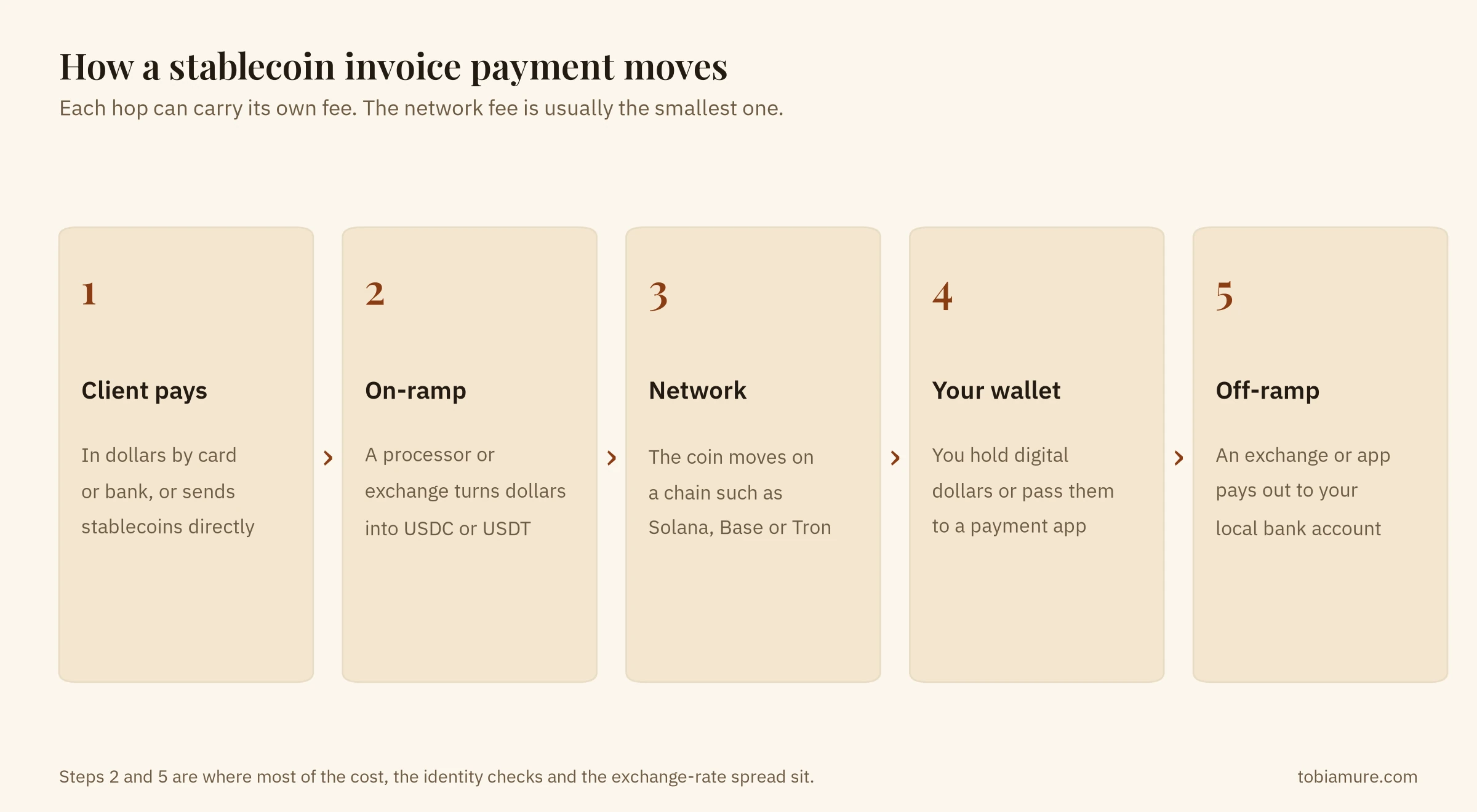
- The client pays. Some clients hold stablecoins and send them directly. Most pay in dollars by card or bank transfer through a processor.
- The on-ramp. If the client pays in dollars, a processor or exchange converts them into USDC or USDT.
- The network transfer. The coin moves on a blockchain, such as Solana, Base, Ethereum or Tron. This takes seconds to minutes.
- Your wallet. You receive the coins in a wallet or a payment app that holds them for you.
- The off-ramp. When you need local currency, an exchange or payment app converts the coins and pays out to your bank account.
The network matters more than most people realise. USDC and USDT exist on many chains. If your client sends USDT on Tron to an address you only use for Ethereum, the money can be very hard to recover. Always state the coin and the network on the invoice.
What it really costs
Start with the benchmark. The World Bank's Remittance Prices Worldwide tracks what it costs to send $200 across borders, including fees and the exchange-rate margin.
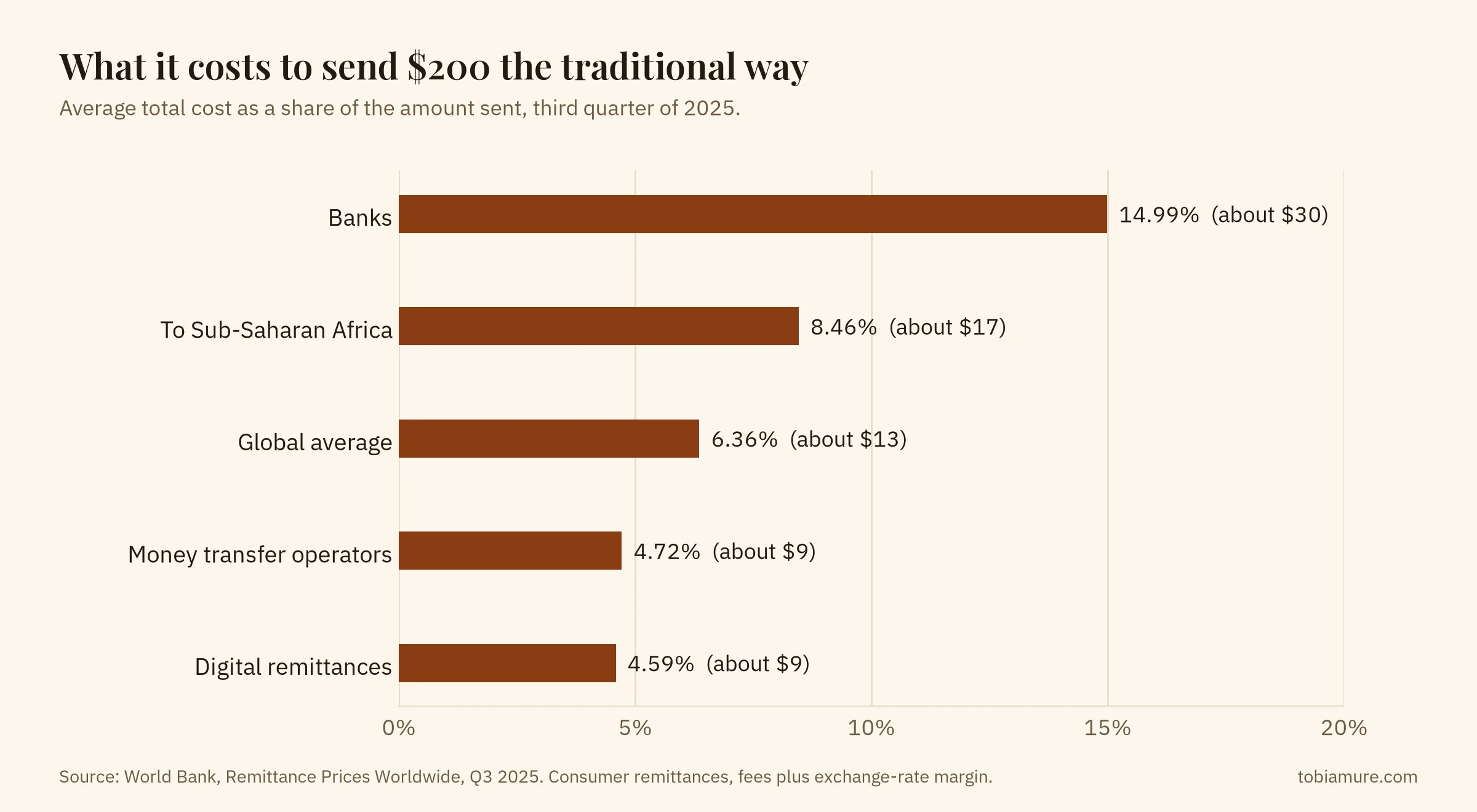
In the third quarter of 2025, the global average was 6.36%. Banks averaged 14.99%, and sending to Sub-Saharan Africa averaged 8.46%, or about $17 on $200. These figures cover consumer remittances, not business invoices, but they show where the friction sits.
Bank wires for larger invoices have their own costs. The median US bank charges $45 for an outgoing international wire and $15 for an incoming one, according to a NerdWallet survey. Intermediary banks can take more along the way.
Now the stablecoin side. The network fee is usually the smallest part. On Solana, Base or Polygon, sending USDC typically costs a fraction of a cent to about a cent. Sending USDT on Tron is more expensive, often around $1 to $4.50 per transfer, more when sending to a new address and less when the sender rents network resources, according to Eco's 2026 fee guide. These fees move with network demand, so treat them as rough guides.
The ramps are where the real cost sits:
| Step | Typical cost | Example |
|---|---|---|
| Client pays through a processor | About 1% to 2% | Stripe charges 1.5% to accept stablecoin payments and settle them in dollars |
| Network transfer | Under a cent to a few dollars | Depends on the chain and network demand |
| Exchange withdrawal fee | A flat fee per withdrawal | OKX lists 1.5 USDT for USDT on Tron; fees vary by exchange and network |
| Converting to local currency | A spread, sometimes large | Compare the rate you get with the official rate on the day |
The comparison that matters is the amount that lands in your local bank account, in local currency, through each route. On a $2,000 invoice, a 1.5% processing fee is $30, which is often cheaper than a wire plus intermediary fees plus a poor exchange rate. On a $100 invoice, the advantage can disappear.
USDC or USDT?
For most freelancers I would put USDC on the invoice by default, and accept USDT when a client asks for it.
The reason is regulation, especially in Europe. Under the EU's Markets in Crypto-Assets rules, known as MiCA, stablecoins offered to the public must come from an authorised issuer. Circle issues USDC and its euro coin, EURC, under a French e-money licence it secured in July 2024. Tether has not sought MiCA authorisation, and Coinbase, Kraken, Crypto.com and Binance's EU entity have delisted USDT for EU retail users, Finance Magnates reported in June.
In practice, that means a European client may find it easier to pay you in USDC or EURC than in USDT.
USDT is still the larger coin. It is also widely used for peer-to-peer trading in many emerging markets, where it can be easier to convert into local currency. Ask your client what they can send, and ask your off-ramp what it pays out best.
Whatever you choose, stick to the big fiat-backed coins. The stablecoins that broke down in late 2025 were synthetic or yield-bearing designs. Stream Finance's xUSD fell more than 75% after the company announced about $93 million of losses on November 4, 2025, Protos reported. Ethena's USDe briefly traded at $0.65 on Binance during the October 10, 2025 market crash while holding near $1 on-chain, according to an analysis by 21Shares. If you cannot tell how a coin keeps its value, it is safer not to accept it for work.
The rules in 2026, by region
United States
The GENIUS Act, signed on July 18, 2025, is the first federal law for payment stablecoins. It requires issuers to back their coins one-for-one with cash, deposits and short-term Treasury bills, to keep those reserves separate, and to publish monthly reserve reports, according to a KPMG summary.
The law takes effect on January 18, 2027, or 120 days after regulators finish their rules, whichever comes first. Regulators missed the July 2026 deadline for those rules, and most are still proposals. The law also bars crypto platforms from offering stablecoins from non-permitted issuers from July 18, 2028, and a Treasury proposed rule published in August sets out how that will work.
For freelancers, the practical effect is more regulated choice. Circle received final approval from the Office of the Comptroller of the Currency for a national trust bank on July 10, and Tether launched a separate US-regulated coin, USAT, in January, Decrypt reported.
European Union
MiCA's stablecoin rules have applied since June 30, 2024. The transition period for crypto platforms ended on July 1, 2026, with no extensions. If you hold coins or cash out through a European platform, expect it to support USDC and EURC rather than USDT.
United Kingdom
The UK is moving more slowly than the EU and the US. The Financial Conduct Authority published its final crypto rules, including stablecoin issuance, on June 30, 2026, with the regime going live on October 25, 2027, according to Elliptic. The Bank of England set out draft rules for large sterling stablecoins in June and said regulated stablecoins can operate in the UK from 2027.
Nigeria
Nigeria has moved from restriction toward regulation. The Investments and Securities Act 2025, signed in March 2025, recognises digital assets as securities and puts them under the Securities and Exchange Commission, TechCabal reported. Since December 2023, the Central Bank of Nigeria has let banks open accounts for licensed virtual asset service providers, though banks still cannot trade crypto on their own account, Nairametrics reported.
In August 2026, the SEC proposed rules that would sort stablecoins into tiers. Naira-backed coins would need 100% reserves and foreign-currency-backed coins 120%. Algorithmic coins would be banned, and foreign stablecoins would need SEC recognition and a local representative, according to a summary by law firm Olaniwun Ajayi. These are proposals, not final rules.
Nigeria also has a naira stablecoin, cNGN, which launched in February 2025 and expanded to the Celo blockchain in August 2026, TechCabal reported. For freelancers, the most useful thing to watch is whether licensed local off-ramps grow, because that is where the naira conversion happens.
Tax: it is still income
Getting paid in stablecoins does not change the tax basics. It is income from your work.
In the US, the IRS treats digital assets, including stablecoins, as property. If you receive them for services, you report their fair market value in dollars as income, and independent contractors report it on Schedule C. Brokers now report digital asset sales on the new Form 1099-DA.
In Nigeria, the Nigeria Tax Act 2025 took effect on January 1, 2026 and treats digital assets as chargeable assets. Individuals' gains are now taxed at personal income tax rates, with a top rate of 25%, rather than a flat 10%, according to Bloomberg Tax. Your freelance fees themselves are income either way.
The simplest habit is to record the dollar value of every payment on the day you receive it, alongside the invoice number. That record is what your accountant will ask for.
Risks to manage
Frozen funds. Issuers can freeze coins at specific addresses. Tether froze $182 million across five Tron wallets on January 11, 2026, CoinDesk reported. If a client pays you from a sanctioned or flagged address, your funds can be caught up. Use a regulated wallet or app that screens incoming payments.
Wrong network or address. Blockchain transfers are final. Confirm your address through a second channel and ask new clients to send a small test payment first.
Platform risk. A wallet app or exchange can fail even if the coin is sound. Do not leave large balances with a platform you have not checked.
Peg risk. Stick to large fiat-backed coins, but remember that lower risk is not zero risk. USDC itself briefly fell to about 87 cents in March 2023, after Circle disclosed $3.3 billion of reserves held at the failed Silicon Valley Bank, CNBC reported. It recovered once US authorities guaranteed the bank's deposits.
A checklist for your next stablecoin invoice
- State the amount in US dollars, plus the coin (for example, USDC) and the network (for example, Solana or Base).
- Put your wallet address on the invoice and confirm it with the client by a second channel.
- Agree who pays the processing and network fees.
- Ask for a small test payment from any new client.
- Use a regulated wallet or payment app that screens incoming funds.
- Record the dollar value and date of every payment for tax.
- Compare the final local-currency amount against your usual bank route at least once a quarter.
Used this way, stablecoins are lower risk, though not risk-free. They are a payment rail, and like any rail they reward people who read the fee schedule.
Frequently asked questions
In most places, yes. The US, EU and UK allow businesses to receive stablecoins, and Nigeria allows banks to serve licensed virtual asset service providers. What is regulated is the issuer and the platforms you use to buy, hold or cash out. Check the rules where you live and use licensed providers.
USDC is easier if you have European clients or want to stay with regulated platforms, because it is authorised under the EU's MiCA rules and USDT is not. USDT is larger and widely used for peer-to-peer trading in many emerging markets. Many freelancers accept both but default to USDC on invoices.
The network fee itself is often under a cent on newer chains and a few dollars on Tron. The bigger costs are converting in and out of local currency. Stripe, for example, charges 1.5% for stablecoin payments. Always compare the total amount that lands in your bank account, not just the transfer fee.
Generally, yes. In most countries, stablecoins received for work are treated as income. In the US, the IRS taxes them at fair market value when received. In Nigeria, the Nigeria Tax Act 2025 treats digital assets as chargeable from January 1, 2026. Speak to a tax adviser about your situation.
Sending to the wrong network or address, receiving funds from a sanctioned or flagged wallet that the issuer can freeze, holding a synthetic or yield-bearing coin that loses its peg, and unclear tax records. Most of these can be managed with a test transfer, a regulated wallet and good bookkeeping.
Related articles

The 99 Percent Funding Rule Every Founder Should Know Before Borrowing Money
Every funding approach has its purpose. A plain-English rule for choosing the right one before you borrow.

How Nigerians earn forex from remote work opportunities
National-press reporting on the remote-work foreign-exchange economy.
Big Tech's $720 Billion AI Build-Out: What Q3 2026 Earnings Need to Show
Amazon, Alphabet, Microsoft and Meta plan to spend at least $720 billion on capital projects in 2026. Here are the numbers behind the plans, who is paying for them, and what to watch as Q3 results land.