 TOBI·AMURE

Big Tech's $720 Billion AI Build-Out: What Q3 2026 Earnings Need to Show
Published October 19, 2026

Finance & Technology Journalist · CFEI®
On Wednesday, Meta opens the third-quarter earnings season for the companies building most of the world's AI infrastructure. Alphabet and Microsoft follow on October 28, and Amazon on October 29.
Between them, these four companies have told investors they will spend roughly $720 billion to $745 billion on capital projects this year. Most of it is going into AI servers, chips, data centers and the power and networking around them.
The questions around that spending have changed quickly. In January 2024, the question was whether Big Tech could justify the AI hype at all. In October 2026, the question is whether the revenue is arriving fast enough to carry the bill.
Here is what the companies have already disclosed, where the strain is showing, and what to look for in each report.
The 2026 spending plans, company by company
Every one of the four has changed its 2026 number at least once this year. Three of them have gone up.
| Company | First 2026 guidance | Latest guidance (July 2026) | What changed |
|---|---|---|---|
| Amazon | About $200 billion (February) | About $220 billion | Raised, citing higher memory costs |
| Alphabet | $175 billion to $185 billion (February) | $195 billion to $205 billion | Raised twice, in April and July |
| Microsoft | About $190 billion (April) | About $175 billion | Lowered by an accounting change, not less spending |
| Meta | $115 billion to $135 billion (January) | $130 billion to $145 billion | Raised in April, low end lifted in July |
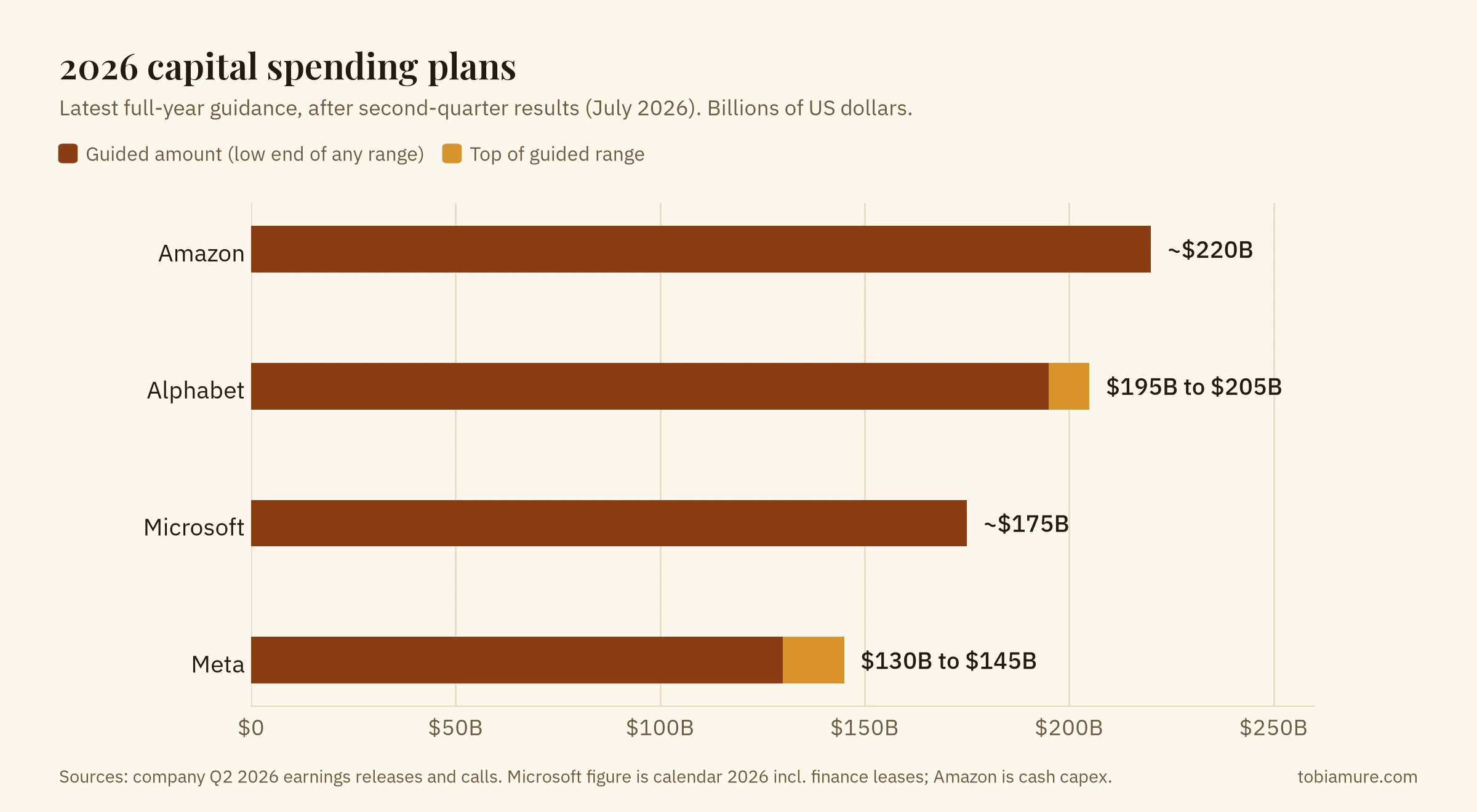
Amazon's increase came with an unusually specific explanation. CEO Andy Jassy said on the company's July 30 earnings call that "the higher cost of memory" had pushed the figure up from a prior estimate of about $200 billion to about $220 billion of cash capex. In other words, part of this year's increase is price, not just volume.
Alphabet raised its range for the second time in three months when it reported on July 22. Its CFO attributed the move to "an acceleration in the delivery of capacity to meet growing demand," according to the call transcript. The company also said it expects capex to "increase significantly in 2027."
Microsoft's number is the one most easily misread. In July it cut its calendar-2026 figure from about $190 billion to about $175 billion. The reason was a change in how long it depreciates data centers and offices, from 15 years to 25 years, which shifts some future leases out of the capex line. "Outside of this useful-life impact, our calendar year 2026 capex investment expectations remain unchanged," CFO Amy Hood said, as CFO Dive reported on July 30.
Meta has been the most cautious about the future. It narrowed its range to $130 billion to $145 billion in its second-quarter release but declined to look further ahead. "We aren't providing a specific outlook for 2027 CapEx at this time," CFO Susan Li said on the July 29 call.
Add Oracle, which guides on a fiscal year ending in May, and the group gets bigger still. Oracle reiterated capex of $90 billion to $95 billion for its fiscal 2027 when it reported in September, ERP Today reported. In late July, FactSet put calendar-2026 guidance for all five close to $800 billion once finance leases and customer prepayments are included.
How fast the spending is growing
The quarterly numbers show the acceleration more clearly than the annual plans.
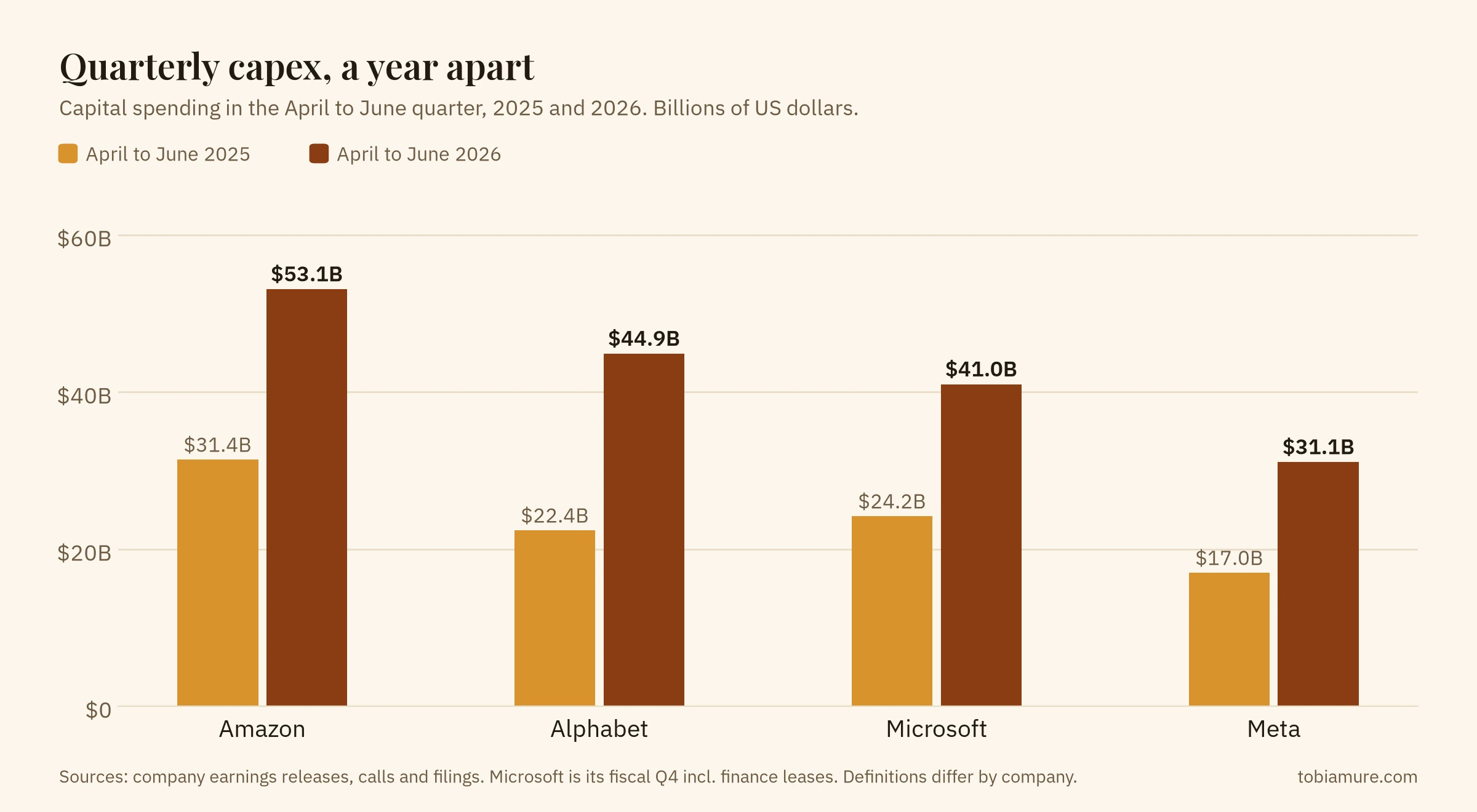
Alphabet spent $44.9 billion on property and equipment in the April to June quarter, double the $22.4 billion of a year earlier, according to its earnings release filed with the SEC. Meta's capex, including finance-lease payments, rose to $31.1 billion from about $17.0 billion, based on the cash flow table in its release.
Amazon's cash capex was $53.1 billion in the quarter, net of proceeds and incentives, according to its earnings release. Microsoft spent $41.0 billion in its fiscal fourth quarter including finance leases, up 69% from a year earlier, Benzinga reported. Hood told analysts the current quarter, which ended in September, would top $50 billion.
Where does the money go? In the second quarter, roughly 60% of Alphabet's technical infrastructure spending went to servers and 40% to data centers and networking, the company said on its earnings call. Microsoft said about two-thirds of its fourth-quarter spending went to short-lived assets such as GPUs and CPUs, according to the call transcript. That split matters, because chips wear out on the income statement much faster than buildings do.
The demand case: cloud growth and backlogs
The bull case rests on one argument. The companies are not building ahead of demand. They are building behind it.
| Cloud business | Latest quarter revenue | Growth | Contracted backlog |
|---|---|---|---|
| AWS (Amazon) | $42.2 billion | 37% | $496 billion |
| Google Cloud (Alphabet) | $24.8 billion | 82% | $514 billion |
| Azure (Microsoft) | Not disclosed separately | 43% | $678 billion commercial RPO |
| Oracle Cloud Infrastructure | $7.4 billion | 121% | $664 billion RPO |
Sources: Amazon release and call, Alphabet release and call, Microsoft call, ERP Today on Oracle. Quarters are April to June 2026, except Oracle (June to August).
AWS grew 37% in the second quarter, its fifth straight quarter of acceleration, and its backlog reached $496 billion. Google Cloud's revenue jumped 82% to $24.8 billion, and its operating income more than tripled to $8.8 billion. Azure grew 43% and passed $100 billion in annual revenue for the first time.
All four also said the same thing about supply. Microsoft said demand still exceeds available capacity. Alphabet said it is supply constrained and will rent third-party capacity as a bridge. Jassy said Amazon "will still not have enough capacity to meet all the demand we have in 2026." Meta said it expects industry capacity to stay "tight for the foreseeable future."
There is a caveat worth reading closely. Microsoft's commercial remaining performance obligations rose 84% to $678 billion, but excluding OpenAI the growth was 25%, according to the call transcript. A large share of the AI backlog sits with a small number of very large customers. That concentration is a risk the headline numbers hide.
The cost: free cash flow and debt
If the demand case is in the backlogs, the cost is in the cash flow statements.
- Alphabet reported negative free cash flow of $5.9 billion in the second quarter, as capex outran $39.1 billion of operating cash flow.
- Meta's free cash flow fell to $0.8 billion from $8.5 billion a year earlier.
- Amazon's free cash flow over the trailing twelve months was an outflow of $7.6 billion, against an inflow of $18.2 billion a year before, its release showed.
- Oracle reported negative free cash flow of $5.4 billion in its June to August quarter.
To close the gap, the companies are borrowing. Alphabet's long-term debt more than doubled to $98.2 billion at the end of June from $46.5 billion at the end of 2025. Meta's rose to $83.7 billion from $58.7 billion over the same period. FactSet calculates that incremental debt funded 32% of the group's capex in the twelve months to June 2026, up from 9% in fiscal 2024, and counts about $820 billion of off-balance-sheet lease commitments across the five.
This is the part of the cycle that feels most different to me. For a decade, the largest technology companies funded almost everything from cash flow. They are now using bond markets, leases and joint ventures with partners such as BlackRock, which is backing a 1-gigawatt Meta data center in El Paso, to keep building.
Accounting choices are now part of the story
Two numbers will shape how this spending shows up in profits: depreciation and useful lives.
Alphabet's depreciation of property and equipment rose 42% year over year to $7.1 billion in the second quarter. That line will keep climbing for years as this year's servers enter service, whatever happens to revenue.
How fast it climbs depends partly on assumptions. Amazon said on its call that it depreciates servers over at least five to six years and data centers over more than 30. Microsoft's move to 25-year lives for buildings lowers its reported capex and gives what CFO Dive described as a "minimal benefit" to fiscal 2027 operating income. None of this is improper. But when profit margins depend on how long a GPU is assumed to last, it is worth reading the footnotes.
The supplier side is still accelerating
The clearest sign that spending has not peaked comes from the company selling the chips. Nvidia's data center revenue rose 117% year over year to $89.0 billion in the quarter ended July 26, and total revenue reached $96.2 billion, according to its August 26 release. Nvidia guided to about $108 billion for the current quarter, assuming no data center sales to China.
Nvidia is also looking further ahead than its customers have. "CapEx by the top 5 hyperscalers is expected to reach nearly $800 billion in 2026 and $1.3 trillion in 2027," CFO Colette Kress said on the company's August 26 earnings call. The hyperscalers themselves have not yet guided for 2027, which is why their Q3 calls matter.
What to watch in each Q3 report
Meta, Wednesday, October 21. Whether it gives any 2027 capex outlook, which it declined to do in July. Also watch free cash flow, which was already close to zero last quarter, and whether its revenue lands inside the $61 billion to $64 billion it guided.
Alphabet, Wednesday, October 28. The size of the 2027 increase it has already flagged as significant. Whether Google Cloud can hold growth near 80% while it rents third-party capacity, and what that does to cloud margins, which Alphabet has warned will see modest pressure.
Microsoft, Wednesday, October 28. Whether quarterly capex comes in above the $50 billion it guided, and whether Azure grows about 45% in constant currency as forecast. Also watch the share of new bookings that comes from OpenAI.
Amazon, Thursday, October 29. Whether the $220 billion plan holds or rises again on memory prices. AWS has accelerated for five straight quarters, so a sixth would strengthen the case that capacity is turning into revenue quickly. Also watch free cash flow, which management has warned will stay under pressure.
Across all four, the most useful single question is the same: is cloud revenue growing faster than depreciation? If it is, the build-out is paying for itself. If depreciation starts to win, the debate about AI spending will get much louder in 2027.
This article is for information only and is not investment advice.
Frequently asked questions
Based on guidance given after second-quarter results in July 2026, Amazon, Alphabet, Microsoft and Meta expect combined 2026 capital expenditures of roughly $720 billion to $745 billion. Most of that goes to AI servers, data centers and networking.
Meta reports on Wednesday, October 21. Alphabet and Microsoft report on Wednesday, October 28. Amazon reports on Thursday, October 29. All four report after the US market close.
Microsoft lowered its calendar-2026 figure from about $190 billion to about $175 billion in July because it extended the useful lives of data centers from 15 to 25 years. That moves some future leases from finance leases, which count as capex, to operating leases, which do not. CFO Amy Hood said spending plans were otherwise unchanged.
Yes, for some companies. Alphabet reported negative free cash flow of $5.9 billion in the second quarter of 2026, Meta's free cash flow fell to $0.8 billion, and Amazon's trailing-twelve-month free cash flow was an outflow of $7.6 billion. Companies are also borrowing more to fund the build-out.
No. Microsoft and Meta include finance leases, Amazon guides on cash capex, and Alphabet reports purchases of property and equipment. The totals are useful for scale, but small gaps between companies should not be over-read.
Related articles

Microsoft, Magnificent 7 must justify AI hype this earnings season
Set the earnings-season bar for what Big Tech actually had to prove on AI.

Getting Paid in Stablecoins as a Freelancer in 2026: Costs, Rules and Risks
Stablecoins can cut the cost and wait of cross-border invoices, but the savings depend on the ramps, not the blockchain. Here is how the money moves, what it costs, and what the 2026 rules mean in the US, EU, UK and Nigeria.

How Much Does a Freelance Finance Writer Cost in 2026? Rates by Format
What editors and fintech teams should expect to pay a specialist finance writer in 2026, by format, with published benchmarks, my own rates, and why the cheapest option often costs more.