 TOBI·AMURE

How Much Does a Freelance Finance Writer Cost in 2026? Rates by Format
Published October 19, 2026

Finance & Technology Journalist · CFEI®
What should a good finance writer cost? It depends on the format, the reporting involved and how fast you need it. But "it depends" is not much help when you are building a budget. So here are the published benchmarks, what drives the price up or down, and where my own rates sit.
I have spent seven years writing about finance for outlets including Investopedia, TheStreet, Inc., Benzinga and TipRanks, and I publish my own rates below so you can compare them with the market.
The short answer
Most editorial and content writing sits between about 25 cents and $1 a word in published benchmarks. Specialist and technical work sits near or above $1.
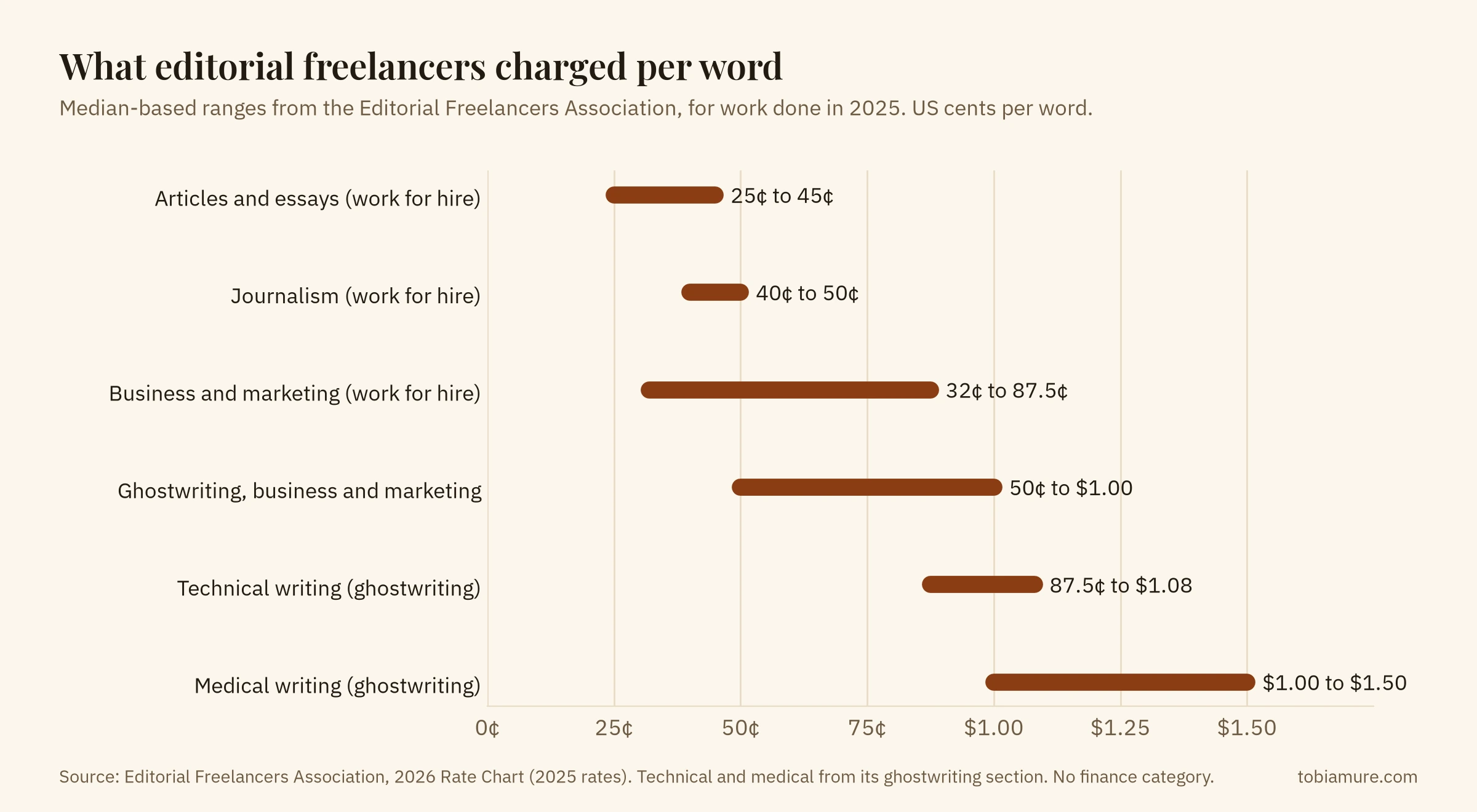
The best current data comes from the Editorial Freelancers Association's 2026 rate chart, which surveyed more than 1,100 members on what they charged in 2025. The EFA does not set rates, and its chart has no separate finance category. But it is the most transparent benchmark available.
For work-for-hire writing, the EFA data put articles at 25 to 45 cents a word, journalism at 40 to 50 cents and business and marketing at 32 to 87.5 cents. Ghostwritten business content ran 50 cents to $1. In the chart's ghostwriting section, technical writing ran 87.5 cents to $1.08 and medical writing $1 to $1.50. For work-for-hire, technical writing was $1 a word and medical writing $1 to $1.50.
Finance content usually sits in the business, ghostwriting or technical bands, depending on how specialised it is. Explaining how a credit card works is not the same job as explaining how a stablecoin issuer holds its reserves.
What it costs by format
Content marketplaces publish their own starting rates. Contently's are a useful floor.
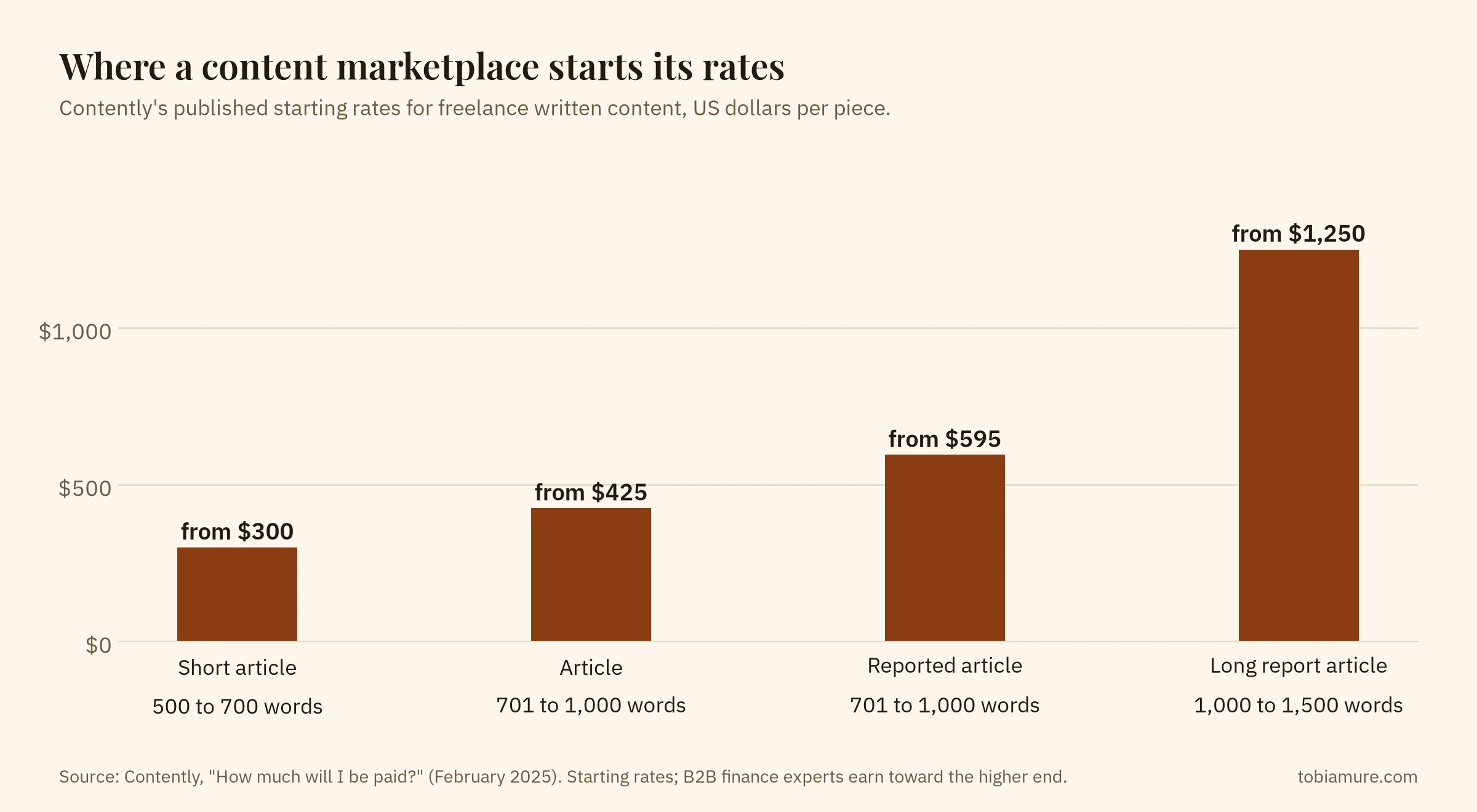
Contently's starting rates run from $300 for a 500 to 700-word article to $1,250 for a long report article of 1,000 to 1,500 words. White papers and e-books start at 85 cents a word. Contently also says writers with B2B finance or enterprise tech expertise earn toward the higher end of its range.
Putting those benchmarks together, here is what I would expect a specialist finance writer to charge in 2026. These ranges are my reading of the published data and the market I work in, not a survey.
| Format | What it usually involves | Typical specialist range |
|---|---|---|
| News or earnings brief, 500 to 800 words | Same-day turnaround, filings and calls, accuracy under pressure | $250 to $600 |
| SEO explainer, 1,500 to 2,000 words | Search intent, structure, sourcing, product or rate detail | $500 to $1,500 |
| Reported feature, 1,500 to 2,500 words | Interviews, original reporting, fact-checking | $800 to $2,500 or more |
| Ghost-bylined thought leadership | Interviewing an executive, matching their voice | $750 to $2,000 |
| Research report or white paper | Data work, analysis, long-form structure | $1,500 to $5,000 or more |
| Monthly retainer | A set number of pieces, beat ownership, priority turnaround | $3,000 to $8,000 a month |
Older surveys point the same way. A Peak Freelance survey of 213 writers, based on data that appears to date from 2021, found that the most common rate for a 1,500-word blog post, chosen by 27% of writers, was $250 to $399, while half of six-figure earners charged $1,000 or more per post. Superpath's 2022 guide described a range from $100 to $250 for generalists, $350 to $700 for specialists and $1,000 or more for technical writers. Rates have moved since, but the gap between generalists and specialists appears to persist.
Why finance writing costs more
Three things push finance rates above general content.
Errors are expensive. A wrong interest rate, a misread earnings figure or an outdated regulation can mislead readers, trigger corrections and, for regulated companies, create compliance problems. Much of what you pay for is the checking you never see.
Search engines hold it to a higher standard. Google's Search Quality Rater Guidelines classify finance as "Your Money or Your Life" content, covering "topics that could damage a person's ability to support themselves and their families." For these pages, the guidelines say "a high level of expertise may be required for the page to be trustworthy." Google's own guidance on helpful content says its systems give "even more weight" to content that shows strong experience, expertise, authoritativeness and trust on these topics.
The subject keeps moving. Over the past year, a finance writer covering payments has had to keep up with GENIUS Act rulemaking, MiCA's transition deadline and a wave of new stablecoin products. Staying current is unpaid time that shows up in the rate.
What moves the price up or down
- Reporting. Interviews, original data and primary documents take time. A piece built only on desk research costs less than one with three expert interviews.
- Turnaround. Same-day earnings coverage costs more than a piece due in two weeks.
- Byline. Ghostwriting under an executive's name usually costs more than a bylined piece, because it involves interviews and voice matching. The Professional Writers Association of Canada's rate guide suggests ghostwritten articles are "generally 2-3 times the usual rate."
- SEO work. Keyword research, briefs, internal links and on-page optimisation add time if the writer handles them.
- Revisions. Know how many rounds are included. One round is common, and extra rounds are often billed.
- Volume. Retainers and packages usually lower the per-piece price in exchange for a commitment.
My own rates, for transparency
I publish my starting rates on my site, because I think it saves both sides time. All prices are in US dollars and include one round of edits.
| Service | Starting rate |
|---|---|
| Article writing (features, explainers, earnings and macro, SEO, iGaming) | From $800 per article |
| Content refreshes | From $450 |
| On-page SEO | From $350 |
| Monthly coverage of a beat | From $4,000 a month, three-month minimum |
| Research and ghost-bylined reports | From $1,800, long-form from $2,800 |
| The Quarter Package | $8,500 for 6 to 10 finished pieces over 90 days |
For timing, I turn around earnings and macro news the same day. A brief-driven 2,000-word article takes three to four business days to first draft, and interviews or original data add two to three days. You can see the full details in my pricing section.
Freelancer or in-house?
If you need a steady flow of finance content, an in-house hire can make sense. It is not automatically cheaper.
The US Bureau of Labor Statistics put median annual pay at $76,910 for writers and authors, $62,200 for news analysts, reporters and journalists and $90,390 for technical writers in May 2025. Those are base salaries, before benefits, software, equipment and the time it takes to manage and train someone.
A specialist on a $4,000 monthly retainer costs $48,000 a year, and you only pay for the output you need. For teams publishing a few finance pieces a week or fewer, that is often the better deal. For teams publishing daily, an in-house writer plus freelance specialists for complex pieces is a common mix.
What AI changed, and what it did not
Studies since ChatGPT consistently show falling demand for routine writing work.
A study of Upwork data by Xiang Hui, Oren Reshef and Luofeng Zhou, later published in Organization Science, found that monthly jobs for writing-related freelancers fell 2% and their monthly earnings 5.2% after ChatGPT's release, Washington University's Olin Business School reported in 2023. A separate study in the Journal of Economic Behavior and Organization found demand for substitutable skills such as writing and translation fell 20% to 50% against its prior trend, as summarised by ETLA.
But a study by Hannane, Demirci and Zhu in Management Science found something more useful for buyers. Postings for automation-prone writing and coding jobs fell 21% within eight months of ChatGPT's launch, but the jobs that remained were more complex and paid more, according to a DIW summary.
For buyers, the lesson is straightforward. Generic explainers have become cheap. Accurate, reported, specialist finance content has not, because AI tools are only as good as the facts underneath them, and in finance those facts change every quarter.
How to tell if a quote is too cheap
A low rate is not always a bad sign. But in finance, watch for these:
- No published finance bylines you can check.
- No questions about your audience, compliance needs or sources.
- A promise to deliver long, technical pieces very quickly at a very low price.
- Statistics without sources, or sources that are aggregators rather than primary documents.
- No mention of fact-checking or revisions.
The cheapest article is the one you do not have to correct.
Credentials: what they mean
Credentials can help, but read them carefully. The CFA relates to investment analysis and the CFP to financial planning. I hold the CFEI, a financial education credential from the National Financial Educators Council. According to FINRA's designation database, it involves online, self-paced training and an exam. It is not an advisory licence. I list it because it reflects how I approach explaining money, not because it makes me a financial adviser.
For most editors, the better test is simpler: read the writer's published work, check it against the sources, and see if it holds up.
If you have a brief, I am happy to quote it. You can get in touch here.
Frequently asked questions
There is no single finance benchmark, but the Editorial Freelancers Association's 2026 chart, based on 2025 rates, puts business and marketing writing at 32 to 87.5 cents a word, ghostwritten business content at 50 cents to $1, and ghostwritten technical writing at 87.5 cents to $1.08 (work-for-hire technical writing: $1). By my reading of the market, specialist finance writers price toward or above the upper half of those ranges.
By my estimate, expect roughly $500 to $1,500 for a well-researched 1,500-word finance article from a specialist, depending on reporting, interviews, data work and turnaround. Contently's published starting rate for a 1,000 to 1,500-word long report article is $1,250.
Per-article or per-project pricing is the most common model and the easiest to budget. Retainers suit teams that want a writer to own a beat each month. Per-word pricing can reward length over clarity, so many B2B buyers avoid it for anything except very standard formats.
Not always. The US Bureau of Labor Statistics put median pay at $76,910 for writers and authors and $90,390 for technical writers in May 2025, before benefits, equipment and management time. If you need fewer than a few pieces a week, a specialist freelancer is often cheaper.
Look for a track record of published, accurate finance work first. Credentials such as the CFA, CFP or CFEI can help, but they mean different things. The CFP and CFA relate to advice and investment analysis, while the CFEI is a financial education credential. Ask what each one covers.
Related articles

Big Tech's $720 Billion AI Build-Out: What Q3 2026 Earnings Need to Show
Amazon, Alphabet, Microsoft and Meta plan to spend at least $720 billion on capital projects in 2026. Here are the numbers behind the plans, who is paying for them, and what to watch as Q3 results land.

Getting Paid in Stablecoins as a Freelancer in 2026: Costs, Rules and Risks
Stablecoins can cut the cost and wait of cross-border invoices, but the savings depend on the ramps, not the blockchain. Here is how the money moves, what it costs, and what the 2026 rules mean in the US, EU, UK and Nigeria.

How to Become a Freelance Finance Writer in 2026: A Working Journalist's Guide
A practical, sourced guide to breaking into freelance finance writing in 2026: the formats that pay, the skills editors test for, the compliance rules that catch new writers out, how AI changed the market, and a 90-day plan to land your first clients.