 TOBI·AMURE

Venture Capital's Exit Problem in 2026: Record Exits, Missing Cash
Published October 19, 2026

Finance & Technology Journalist · CFEI®
On paper, 2026 has been one of the best years ever for venture capital exits.
US venture-backed exit value reached about $2.29 trillion through the end of September, according to the Q3 2026 PitchBook-NVCA Venture Monitor. Acquisitions of venture-backed companies alone were worth $465.3 billion, a decade high.
Look one level down and the picture changes. "This year's numbers will look like a boom at the top line," Nizar Tarhuni of PitchBook said, according to SiliconANGLE. "But for most of the market, the liquidity won't show up, and that will have a large impact going into 2027."
That gap, between record exit value and cash that has not reached investors, is venture capital's exit problem.
Four companies made up 93.5% of exit value
Four companies accounted for 93.5% of venture exit value in 2026 as of early August, PitchBook's Kyle Stanford wrote.
The biggest was SpaceX. It priced its IPO on June 11 at $135 a share, raising $75 billion at a valuation of about $1.77 trillion, Chronicle.lu reported. It closed its first day up about 19%, according to Renaissance Capital.
SpaceX was also behind the two largest acquisitions of venture-backed companies on record, according to PitchBook. It completed its share-swap acquisition of xAI in February, QNA reported. In August it closed its $60 billion all-stock purchase of Cursor maker Anysphere, VKTR reported. The Cursor deal alone was 53.1% of US venture exit value in Q3, SiliconANGLE reported.
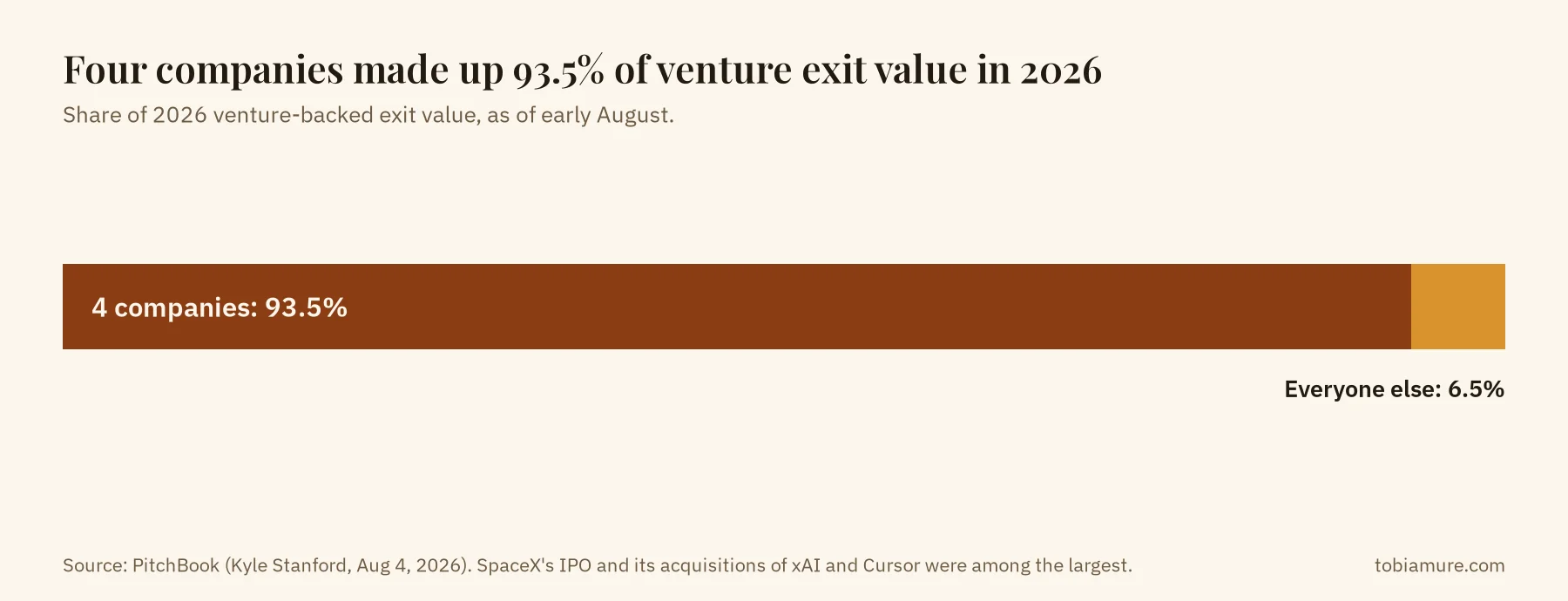
Exits that size are a win for the funds that hold those shares. They are not a market-wide release of cash.
Even for SpaceX's own investors, much of the gain is still on paper. A small public float and lock-up rules mean liquidity has not yet reached most fund investors, PitchBook reported. An all-stock acquisition like Cursor pays in shares, not cash.
The IPO window opened, then narrowed
The second quarter was a record for IPO proceeds. US IPOs raised $104.8 billion across 48 deals, and Renaissance Capital's IPO index ended the quarter with a 42% gain, according to its Q2 review.
Some of the venture-backed listings did very well on day one:
- Cerebras, the AI chip company, priced at $185 a share on May 13, $25 above the top of its range, and closed its first day at $311.07, up 68%, IPOScoop reported.
- Quantinuum, the quantum computing company, raised about $1.7 billion at a $15.6 billion initial market value in June, Crunchbase reported.
- Bending Spoons, the Italian technology company, debuted on July 1 at $29 a share, Reuters reported.
The third quarter was quieter. Renaissance counted 30 US IPOs raising $32.8 billion, but $26.5 billion of that came from a single US offering by SK hynix, the South Korean chipmaker, according to its Q3 review. Without it, the quarter raised $6.2 billion.
Only 18 venture-backed companies went public in Q3, according to the PitchBook-NVCA Venture Monitor. Twelve were in healthcare. None were AI companies.
Several planned listings were pulled late in the quarter. Oura, the smart ring maker, launched a $2.2 billion IPO on September 21 and then postponed it, IFR reported. About 73% of the shares on offer were to be sold by existing holders, The Next Web reported. IFR said the real issues were valuation and lock-up terms, and that Holtec, Bamboo Insurance and SB Energy also postponed deals.
Some of the largest private companies are in no hurry. "We will be a public company. I just think this is a terrible year to go public," Databricks chief executive Ali Ghodsi told Bloomberg in June, as reported by Let's Data Science. OpenAI has ruled out a 2026 listing, according to PitchBook.
Anthropic is reportedly preparing to list in November at a valuation of $1.8 trillion to $2 trillion, Bloomberg reported, citing people familiar with the plans, as summarized by Nairametrics. The company has not confirmed a date.
Some exits came in far below private valuations
Not every exit was a win. Some well-known startups sold for a fraction of their last private price.
Bending Spoons agreed in August to buy Airtable for about $1.29 billion in cash, Reuters reported. PitchBook noted that Airtable had previously been valued at $11.7 billion. It also said Miro is expected to sell for about $1.4 billion, against a $17.5 billion Series C valuation, and described both as discounts of "nearly 90%" to prior marks, in its Q3 report.
These deals return some cash. They also show what the exit market will pay for companies priced at 2021 levels.
Fund investors are still waiting for cash
Limited partners, the pension funds, endowments and family offices that invest in VC funds, judge returns on cash, not paper gains.
On that measure, the picture is weak. Since 2022, net cash flow to LPs has been negative $202 billion, PitchBook's Stanford wrote. In other words, LPs have paid into funds far more than they have received back.
US venture funds from the 2021 vintage had returned an average of just 0.05 times investors' money after five years, PitchBook reported. That is "the lowest of any vintage after five years since 1997." On paper, the same funds are worth 1.21 times what went in.
PitchBook argued that this is not necessarily a warning sign. The 2012 vintage had returned 0.15 times at year five and reached 2.04 times by year 10. Venture returns take time.
Carta's data points the same way. For funds from 2019 and 2020, "median DPIs are still barely over zero," and less than half have returned any capital, Carta reported in its Q1 2026 fund performance study of 2,775 funds.
"With a lack of liquidity, LPs need to shift how they allocate to VC," Stanford said in a July PitchBook article.
Secondaries are filling part of the gap
When exits are slow, investors sell stakes to each other. That secondary market has hit records.
Across all private-market strategies, secondary volume in the first half of 2026 was:
- $118 billion, according to Jefferies.
- $121 billion, according to Evercore.
- About $124 billion, according to Lazard.
Each adviser counts a different set of deals, so the totals differ. All three call it a record.
Venture is a small part of that market, and it trades at a discount. Jefferies put average venture pricing at 79% of net asset value. Evercore put venture secondary volume at about $5 billion in the half, flat on a year earlier. "Venture secondaries await their moment, with volume flat as dry powder builds," it wrote.
For US venture specifically, PitchBook estimated a $121.7 billion secondary market over the 12 months to June 2026, most of it direct sales of startup shares, in its Secondary Market Watch. That included $19.1 billion of tender offers, where a company or its investors buy shares from employees and early backers. OpenAI ($6.6 billion), Anthropic ($5.5 billion) and SpaceX ($2.6 billion) ran the largest in that period, PitchBook said.
Pricing depends heavily on when a company last raised. Shares in companies whose last round was in 2021 traded at a median discount of 59%, against 45% for 2023 rounds, according to Forge data cited in the Q3 Venture Monitor.
"We've reached a tipping point where secondaries are normalized," Brian Borton of StepStone said in the same report.
The money is going to the biggest funds
The lack of cash coming back shapes where new money goes.
US venture funds raised $108.5 billion across 699 funds through Q3, up 38.6% on the $78.3 billion raised in all of 2025, according to the PitchBook-NVCA Venture Monitor. But funds of $500 million or more took 78.1% of that capital while making up just 6% of funds. Andreessen Horowitz alone raised $23.8 billion.
Smaller and newer managers are being squeezed. The number of emerging firms closing a fund fell from 927 in 2022 to 440 in 2025 and 211 so far in 2026, the report said.
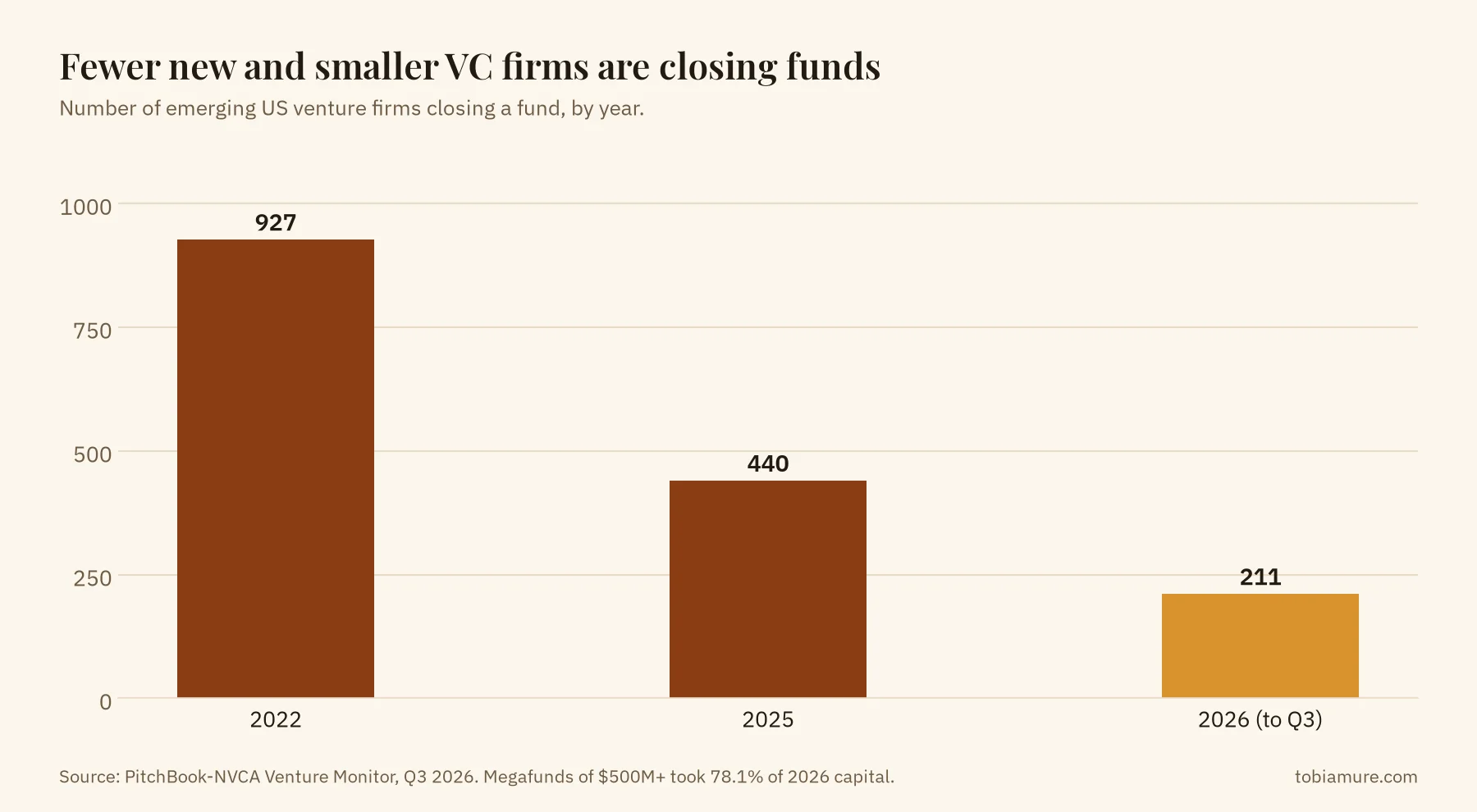
LPs who are short of cash back tend to recommit to the firms they already know. That makes the funding market more concentrated, just as exits are.
What would fix it
The exit problem does not need a boom. It needs breadth: more mid-sized IPOs and acquisitions that return cash to more funds.
Three things to watch:
- Whether Anthropic lists, and how it trades. A successful listing at that size could reopen the window for other AI companies, none of which went public in Q3.
- Whether 2021-priced companies reset. Airtable and Miro show the cost. More companies may accept lower prices to give investors an exit.
- Whether secondaries keep growing for venture. Continuation funds and tender offers are now a normal way for funds to return cash before an IPO.
Until then, venture's record year will look different depending on where you sit. For the holders of a handful of giant companies, it is a boom. For most funds and their investors, the cash is still on the way.
I cover capital markets, AI infrastructure and venture capital. For data-led reporting on where the money is moving, get in touch.
Frequently asked questions
Exit value is high, but it sits with a handful of very large companies. Most venture-backed companies have not listed or been bought, IPO windows have opened and closed quickly, and many private valuations from 2021 are above what public or strategic buyers will pay. That leaves fund investors waiting for cash.
DPI, or distributions to paid-in capital, is the cash a fund has returned to its investors divided by the money they put in. A DPI of 1.0 means investors have their money back. PitchBook reported that 2021-vintage US VC funds averaged 0.05 at year five.
For all private-market strategies, Jefferies counted $118 billion of secondary volume in the first half of 2026, Evercore $121 billion and Lazard about $124 billion. For US venture specifically, PitchBook estimated a $121.7 billion market over the 12 months to June 2026, including $19.1 billion of tender offers.
The largest was SpaceX, which raised $75 billion at a valuation of about $1.77 trillion in June. Others included Cerebras in May, Quantinuum in June and Bending Spoons in July. Oura postponed its planned $2.2 billion IPO in late September.
Related articles
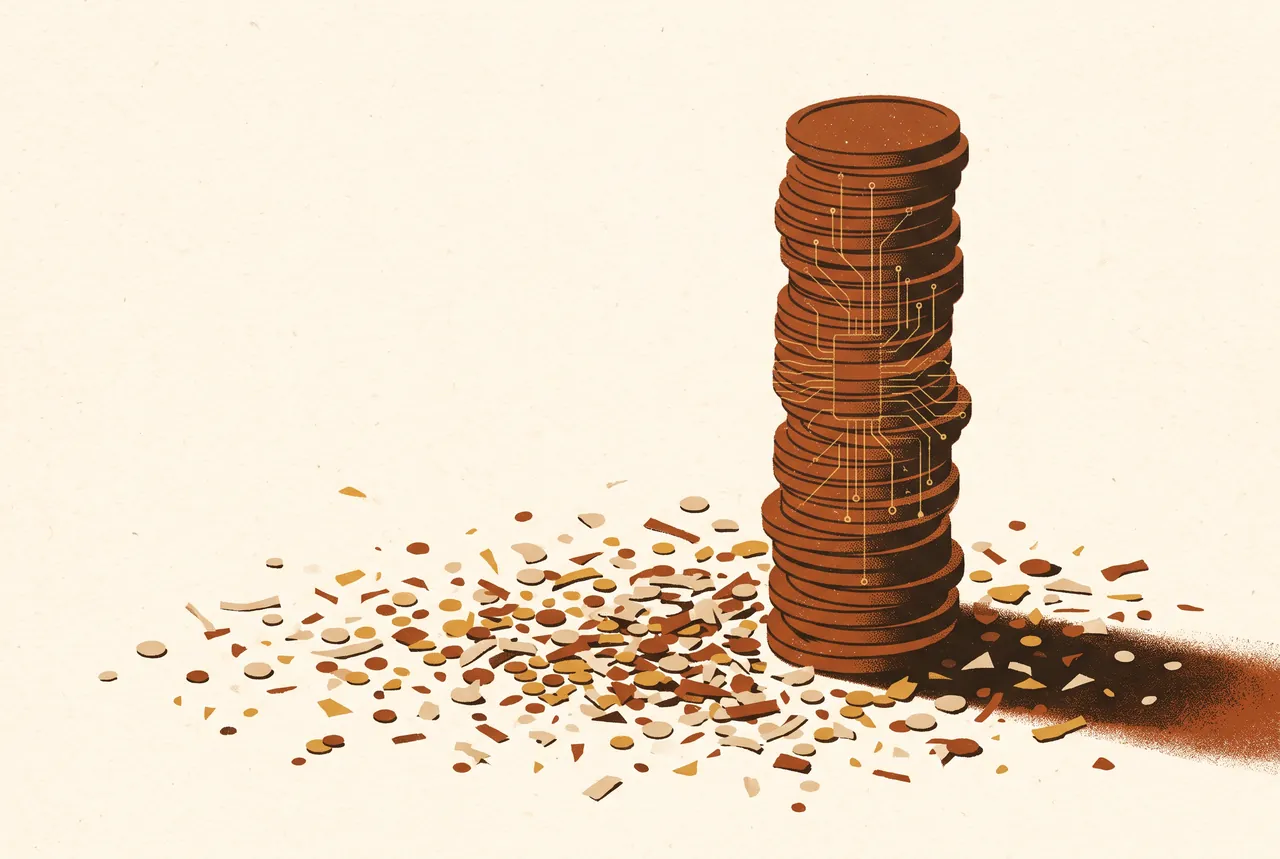
Where Venture Capital Went in Q3 2026: AI Took Two of Every Three Dollars
Global venture funding fell to $159 billion in Q3 2026, its quietest quarter of the year, yet AI still took 64% of it and a record 27 companies raised $1 billion or more. Here is where the money went, and what was left for everyone else.
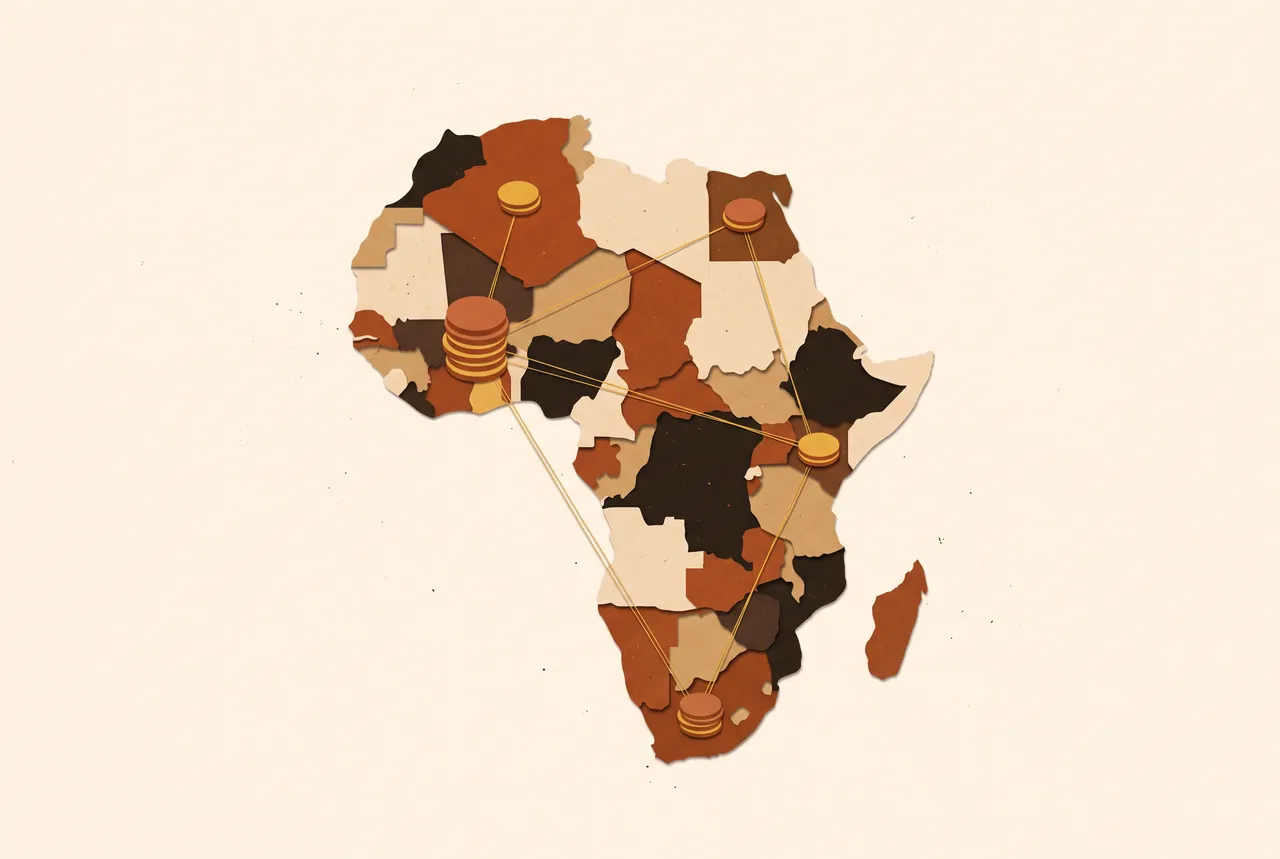
Venture Capital in Africa in 2026: Equity Is Back, Debt Is Down, and Nigeria Is Swinging
African startups raised $2.16 billion in the first nine months of 2026, roughly flat on last year. Underneath, equity rose 23% and debt fell by a third. Nigeria went from its weakest share on record in 2025 to the top of the equity table, then had a near-empty September.
Big Tech's $720 Billion AI Build-Out: What Q3 2026 Earnings Need to Show
Amazon, Alphabet, Microsoft and Meta plan to spend at least $720 billion on capital projects in 2026. Here are the numbers behind the plans, who is paying for them, and what to watch as Q3 results land.