 TOBI·AMURE
Venture Capital in Africa in 2026: Equity Is Back, Debt Is Down, and Nigeria Is Swinging
Published October 19, 2026

Finance & Technology Journalist · CFEI®
African startups raised $2.16 billion from January to September 2026, according to Africa: The Big Deal, the tracker run by Max Cuvellier Giacomelli and Maxime Bayen. That is 4% below the $2.24 billion raised in the same months of 2025.
Flat totals hide the real story. The type of money changed. Equity rose 23% to $1.5 billion, while debt fell 33% to $669 million, from about $1 billion a year earlier, The Big Deal reported.
"For now, 2026 is an equity year," Cuvellier Giacomelli wrote in the Q3 update.
2025 was a rebound built on debt
To read 2026, start with 2025. African startup funding rose 40% to $3.2 billion that year, The Big Deal reported, after falling 35% in 2023 and 25% in 2024. Sixty-nine startups raised $10 million or more, up from 40.
Debt drove much of that recovery. Partech Africa, which counts debt and defines African startups by primary market rather than headquarters, put 2025 funding at $4.1 billion, with a record $1.6 billion in debt, in its annual report. Debt made up 41% of capital, up from 31% in 2024 and 17% in 2019.
The African Private Capital Association (AVCA) showed the same split from another angle. Venture equity fell 21% to $2.1 billion in 2025, while venture debt rose 91% to $1.8 billion, according to its 2025 VC report. Briter counted $3.8 billion of disclosed funding, up 32%, with debt passing $1 billion for the first time in a decade, in its 2025 report.
Debt is a different kind of money from venture equity. It has to be repaid, so lenders generally favor companies with assets or steady cash flows to lend against.
In 2026, the mix swung back to equity
This year, debt has pulled back. Debt was 31% of funding from January to September 2026, down from 45% in the same period of 2025, The Big Deal reported. On a rolling 12-month basis, debt peaked at a record $1.4 billion in March 2026 and has since fallen to $840 million.
Energy is the clearest example. Energy debt totaled $93 million so far in 2026, against $585 million in the first three quarters of 2025, The Big Deal said.
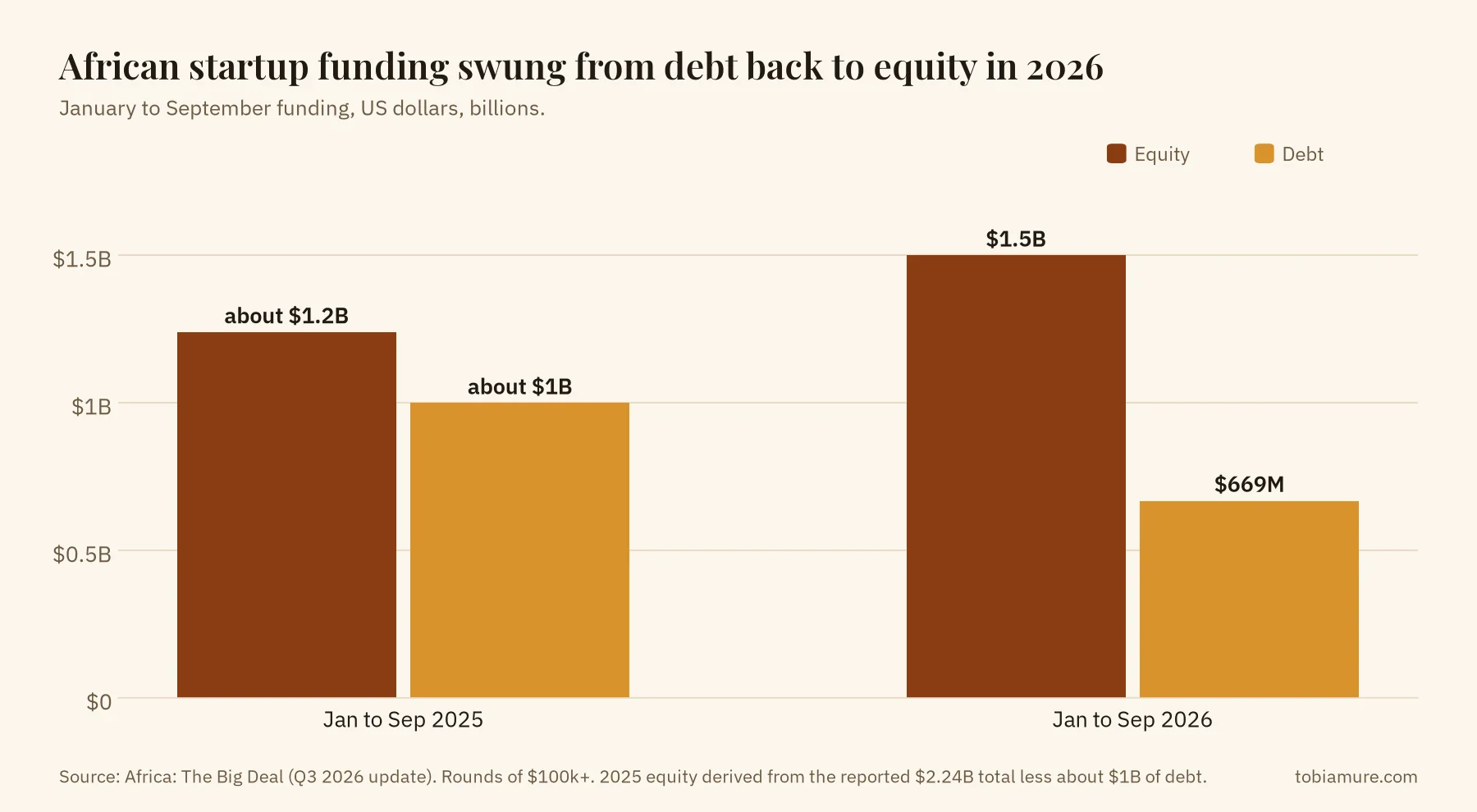
Equity, meanwhile, picked up. Third-quarter funding was $797 million, close to the $804 million of Q3 2025. But Q3 equity was $580 million, against $236 million a year earlier.
Not every tracker sees the debt trend the same way. Launch Base Africa, which tracks a smaller set of disclosed deals, reported the debt share rising to 36.7% in the first half of 2026 from 18.5% a year earlier, in its H1 review. Method matters, which is why I compare like with like below.
Fewer startups are getting funded
The total held up, but the number of funded startups did not. In the first half of 2026, 190 African startups raised $100,000 or more, "the lowest tally since at least 2021," The Big Deal reported. The number of startups raising between $100,000 and $1 million fell 44% from the previous half.
AVCA counted 182 venture deals in the first half, down 24% and the lowest first-half count since 2020, in its H1 report. Three megadeals made up about two-thirds of the value.
So, as in the global market, more of the money is going to fewer companies. Cuvellier Giacomelli warned that "the underinvestment in early stages will eventually create a pipeline issue unless it gets corrected swiftly," in the H1 analysis.
The Big Four still dominate
Kenya, Egypt, South Africa and Nigeria took 82% of African startup funding in 2025, according to The Big Deal. Kenya led with almost $1 billion, much of it debt. Egypt raised $614 million and South Africa $600 million.
The order changed in 2026. In the first half, Egypt led with $327 million, a record 27% share, The Big Deal reported. Nigeria came second with $254 million. Kenya raised $126 million and South Africa $83 million.
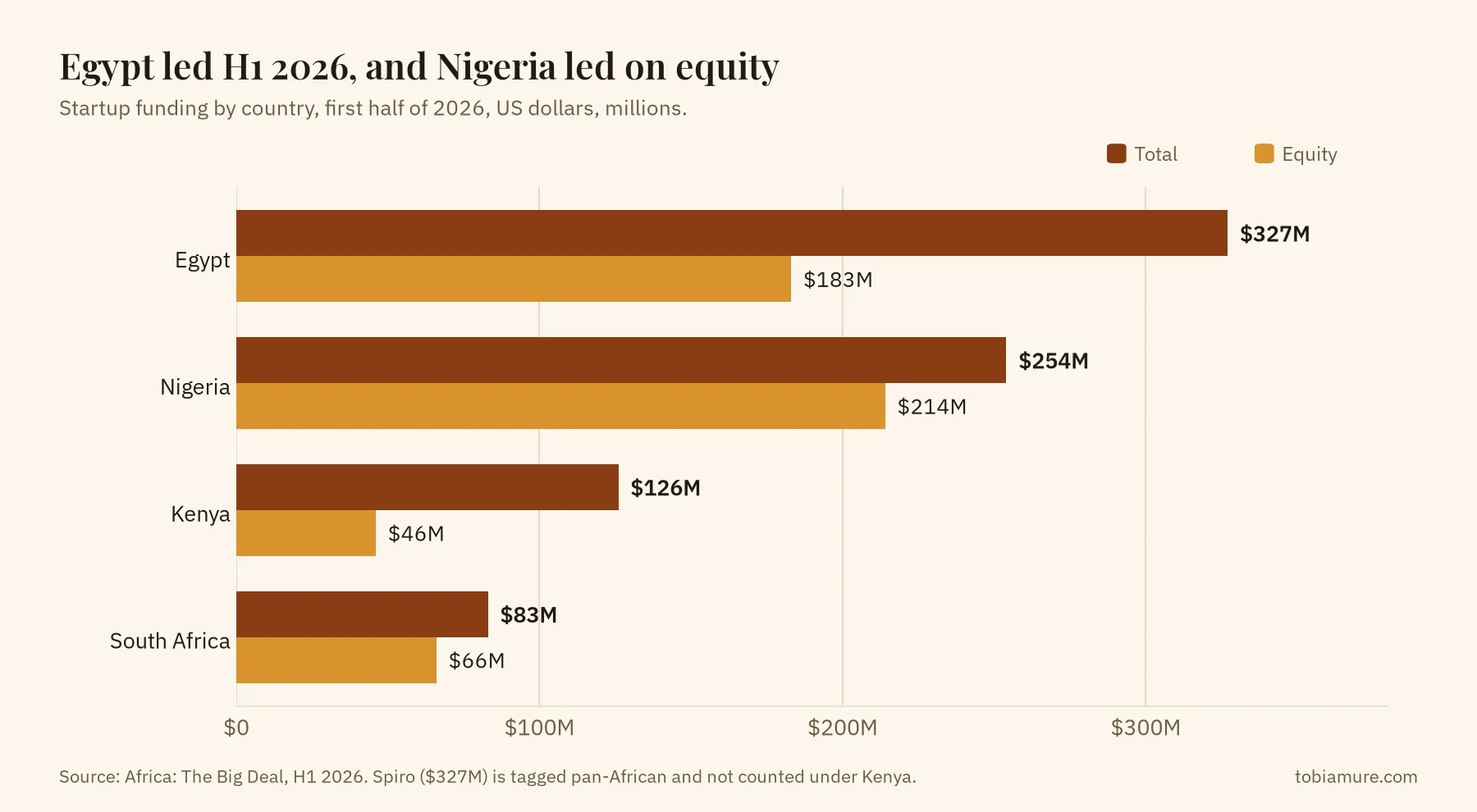
The Big Four's share fell to 58% in the first half. Part of that is a labeling question. Spiro, the electric motorbike and battery-swap company, raised $270 million in equity and $57 million in debt in the first half, The Big Deal said, and the tracker tags it as pan-African rather than as a Kenyan company. Spiro alone accounted for 24% of all African funding in the half, according to its sector breakdown.
Nigeria: from a record low to the top of the equity table
Nigeria raised $343 million in 2025, just 11% of African funding, The Big Deal reported. That was down from 19% in 2024 and, in the tracker's words, "the lowest share we've ever recorded for Nigeria since we started tracking the numbers back in 2019." Nigeria still led on the number of startups raising $100,000 or more, with 86.
Other trackers ranked it higher, which shows how much method matters. Partech put Nigeria fourth with $572 million, including $160 million of debt, in its 2025 report. Disrupt Africa put Nigeria first with $464.8 million, in its 2025 funding report.
The first half of 2026 looked different. Nigeria's $254 million made it second overall, and its $214 million of equity put it first on equity, The Big Deal reported. It was the first time Nigeria passed $250 million in a half since 2022. It also had the most startups raising $100,000 or more.
Then came the swings. In August, Nigerian startups raised $364 million, about 80% of all African funding that month, according to The Big Deal. Most of that was Moove, the Nigerian-born mobility company, which raised a $250 million Series C at a $2.1 billion valuation led by Mubadala, according to its announcement.
In September, Nigerian startups raised $11.3 million across nine companies, down 97% from August, Nairametrics reported.
That pattern is the main thing to understand about Nigerian venture data. One large round, sometimes for a company that now operates mostly outside Nigeria, can make or break a month. Look at the number of funded startups and the half-year trend, not a single month.
The macro backdrop in Nigeria has eased
Nigeria's interest rates and inflation have come down from their peaks, which matters for both investors and the startups they back.
The Central Bank of Nigeria cut its monetary policy rate to 23% at its September 21 to 22 meeting, from 26.5%, according to the CBN's policy decisions page. It had held the rate at 27.5% through mid-2025.
Headline inflation fell to 14.63% in September 2026 from 15.39% in August, according to figures from the National Bureau of Statistics reported by Voice of Nigeria. Food inflation was 19.59%.
The naira ended 2025 at about N1,429 to the dollar, against about N1,535 a year earlier, its first annual gain in about 13 years, Blueprint reported, citing CBN data. It traded near N1,333 on October 12, 2026, according to Nairametrics.
For a dollar-based fund, a more stable naira lowers one of the biggest risks of investing in Nigeria: that the local revenue of a startup shrinks when converted back to dollars.
On regulation, Nigeria's Investments and Securities Act 2025 recognizes virtual and digital assets as securities, ICIR reported. In August 2026 the Securities and Exchange Commission published proposed rules on digital asset operations, custody and markets for public comment, on its website. Those rules are not final.
Fintech still leads, and climate is a third of everything
Fintech took $556 million, or 41%, of African funding in the first half of 2026, according to The Big Deal. Logistics and transport took 35%, mostly because of Spiro. Energy and water fell to 4%, from 20% to 27% in 2023 to 2025.
Climate tech, which The Big Deal counts across sectors, made up 39% of funding, close to its 38% share in 2025.
In Nigeria, fintech made up 56% of equity funding in 2025, followed by commerce at 20%, according to Partech.
Local funds are raising again
The supply of new venture funds is improving after a very weak 2025. Only six Africa-focused VC funds reached a final close in 2025, raising $107 million in total, according to AVCA. In the first half of 2026, final and interim closes reached $558 million, more than all of 2025, AVCA reported.
Abuja-based Ventures Platform closed its Pan-African Fund II at $84 million, above its $75 million target, with the EBRD, Norfund and IFC among its investors, TechEconomy reported in August. Novastar Ventures closed its third fund at $147 million in March, it announced.
New funds take time to deploy, but they are the main source of the early-stage checks that The Big Deal says are now missing.
Why the numbers never match
African funding trackers disagree more than most, and it is worth knowing why before you quote any of them:
- Deal size. The Big Deal counts rounds of $100,000 or more. Partech counts rounds of $200,000 or more.
- Debt. Some trackers fold debt into the total. AVCA reports equity and debt separately.
- Who counts as African. Partech counts startups whose main market is Africa, even if they are headquartered abroad. The Big Deal tags some companies, like Spiro, as pan-African.
- Disclosure. Many African rounds are never announced, so every total is a minimum.
That is how Nigeria can be first on one 2025 list and fourth on another. Pick one tracker and follow its trend.
What to watch in Q4
Three numbers will tell you where African venture capital is heading.
First, whether 2026 reaches about $3 billion. The Big Deal said in September that the year's total "should flirt with the $3 billion mark," in its update.
Second, the number of startups raising early rounds. If it keeps falling, the pipeline problem Cuvellier Giacomelli flagged becomes real.
Third, Nigeria without its outliers. Strip out the single biggest round in any month and look at what is left. That is the clearest read on the depth of the market.
I write about capital markets, fintech and venture capital, with a focus on how money moves into and out of Africa. If your publication or fund wants data-led coverage of African tech, get in touch.
Frequently asked questions
It depends on the tracker. Africa: The Big Deal counted $3.2 billion, up 40%. Partech Africa counted $4.1 billion including $1.6 billion of debt. AVCA counted $3.9 billion, Briter $3.8 billion and Disrupt Africa a minimum of $1.64 billion. They differ mainly on deal-size thresholds, whether debt is included and how they define an African startup.
Africa: The Big Deal counted $2.16 billion from January to September 2026, against $2.24 billion in the same period of 2025. Equity made up $1.5 billion and debt $669 million.
Kenya, Egypt, South Africa and Nigeria, often called the Big Four. They took 82% of 2025 funding on The Big Deal's count. In the first half of 2026, Egypt led with $327 million, followed by Nigeria with $254 million, Kenya with $126 million and South Africa with $83 million.
By number of funded startups, usually yes. By dollars it varies. Nigeria was fourth in 2025 on The Big Deal's and Partech's counts, and first on Disrupt Africa's. In the first half of 2026 it was second overall and first for equity, according to The Big Deal.
Related articles
Where Venture Capital Went in Q3 2026: AI Took Two of Every Three Dollars
Global venture funding fell to $159 billion in Q3 2026, its quietest quarter of the year, yet AI still took 64% of it and a record 27 companies raised $1 billion or more. Here is where the money went, and what was left for everyone else.

Venture Capital's Exit Problem in 2026: Record Exits, Missing Cash
SpaceX's $75 billion IPO helped push US venture-backed exit value past $2 trillion this year. But as of early August, four companies made up 93.5% of 2026 exit value, only 18 venture-backed companies listed in Q3, and the investors in VC funds are still waiting for most of their money back.
Big Tech's $720 Billion AI Build-Out: What Q3 2026 Earnings Need to Show
Amazon, Alphabet, Microsoft and Meta plan to spend at least $720 billion on capital projects in 2026. Here are the numbers behind the plans, who is paying for them, and what to watch as Q3 results land.