 TOBI·AMURE

How to Become a Freelance Finance Writer in 2026: A Working Journalist's Guide
Published October 19, 2026

Finance & Technology Journalist · CFEI®
The first thing to know about freelance finance writing is that nobody checks your degree. They check your numbers.
I studied pharmacy. Today I write about AI infrastructure, payments, markets and crypto for TheStreet, Inc., FinanceFeeds and others. My work has also appeared in Benzinga, TipRanks, GOBankingRates and DailyForex. I started on the crypto news desk at Watcher Guru, where I worked as a crypto news editor and SEO specialist, and in 2022 I was writing crypto news for Investopedia.
None of that required a finance qualification to start. It required learning to read a filing, check a figure twice and write a sentence a nervous reader can follow.
This guide is the one I would have wanted when I started. It builds on a good earlier piece by finance writer Damilola Esebame, whose 2024 guide on LinkedIn covers the basics well and kindly lists me among writers to follow. This version goes further. It covers what the job looks like in 2026, what editors actually test for, the rules that catch new writers out, what AI changed, and a 90-day plan you can start this week.
It is long. Use the table of contents to jump to the part you need.
What a freelance finance writer actually does in 2026
A freelance finance writer produces content about money for clients who are not their employer. That covers far more than personal finance blogs.
Here are the main formats, roughly in order of how often new writers are hired for them.
| Format | What it involves | Typical client |
|---|---|---|
| Explainers and SEO guides | Answering a search question clearly and accurately, such as how a high-yield savings account works | Personal finance sites, fintech blogs |
| News and earnings coverage | Fast, accurate reporting on filings, results, rate decisions and market moves | Financial news sites |
| Market and stock analysis | Opinion or analysis on a company or asset, with clear disclosure | Investing sites, contributor networks |
| Product reviews and comparisons | Comparing cards, accounts, brokers or apps, often with affiliate links | Comparison and review sites |
| B2B fintech content | Explaining infrastructure, such as payments, lending or compliance software, to business buyers | Fintech and software companies |
| Thought leadership and ghostwriting | Writing under an executive's name after interviewing them | Banks, asset managers, startups, agencies |
| Research reports and white papers | Long, data-led documents that support sales or reputation | Financial firms, data providers |
| Newsletters | Regular briefings for subscribers or clients | Publishers, advisers, fintechs |
Most writers start with explainers, because the bar is clearer and there is a steady supply of briefs. The better-paid work sits further down the table, where you need interviews, data or subject depth.
The common thread is accuracy. A lifestyle writer who gets a detail wrong loses some credibility. A finance writer who gets an interest rate, a tax threshold or an earnings figure wrong can mislead someone into a costly decision. That is why the job exists as a specialty at all.
Is there still demand? The honest picture
The market for finance writing is real, but it is uneven. You should go in knowing both halves.
The cautious half comes from the US Bureau of Labor Statistics. It put median pay for writers and authors at $76,910 in May 2025, and projected "little or no change" in employment from 2025 to 2035, according to its Occupational Outlook Handbook. It still expects about 11,900 openings a year, mostly to replace people who leave. It also found that 65% of writers and authors are self-employed, and warned that freelancers "may face the pressures of juggling multiple projects or continually looking for new work."
The encouraging half comes from the buyers. In a 2025 survey of 400 senior marketers at B2B technology companies in the US, UK, France and Germany by 10Fold and Sapio Research, 91% said they were increasing content output and 88% said they use outside partners, FinTech Futures reported. Budgets grew more slowly than output, with 75% reporting increases of only 1% to 10%. Banks are also spending. Analysing the ABA Bank Marketers Survey, EMARKETER found that 82.1% of bank marketers planned to increase spending on digital ads and on search marketing.
Independent work in general keeps growing. MBO Partners counted a record 74.9 million independent workers in the US in 2026.
Put together, the picture is this. Companies want more finance content and expect it to cost about the same. That squeezes generic writing and rewards writers who can produce accurate, specialist work without much hand-holding. The rest of this guide is about becoming that writer.
Do you need a finance degree or a credential?
No. You need knowledge, and there are faster ways to get it than a degree.
Editors and content leads care about three things: whether your facts are right, whether your sources are primary, and whether readers can follow you. A degree in finance or economics helps, but plenty of strong finance writers come from journalism, law, engineering, science or other careers. A science background in particular trains you to respect data and admit what you do not know, which is most of the job.
Credentials can still be useful, as a structured way to learn and as a trust signal. But they mean very different things, and you should never present one as more than it is.
| Credential | Issuer | What it signals | Cost and effort (2026) |
|---|---|---|---|
| SIE (Securities Industry Essentials) | FINRA | Knowledge of securities markets, products and rules | $100 exam, 75 questions, open to anyone 18 or older |
| CFEI (Certified Financial Education Instructor) | National Financial Educators Council | Training in teaching personal finance | $396, self-paced, online exam |
| AFC (Accredited Financial Counselor) | AFCPE | Financial counseling skills and practice | Education packages $550 to $1,525 plus a $75 registration fee and $750 exam, or a $450 bundle in registered university programs, plus 1,000 counseling hours |
| CFP (Certified Financial Planner) | CFP Board | Professional financial planning, with ethics duties | Registered coursework, a bachelor's degree, exam fee $925 standard, 6,000 hours of experience |
| CFA (Chartered Financial Analyst) | CFA Institute | Deep investment analysis | Three exam levels, Level I $1,490 at the standard deadline |
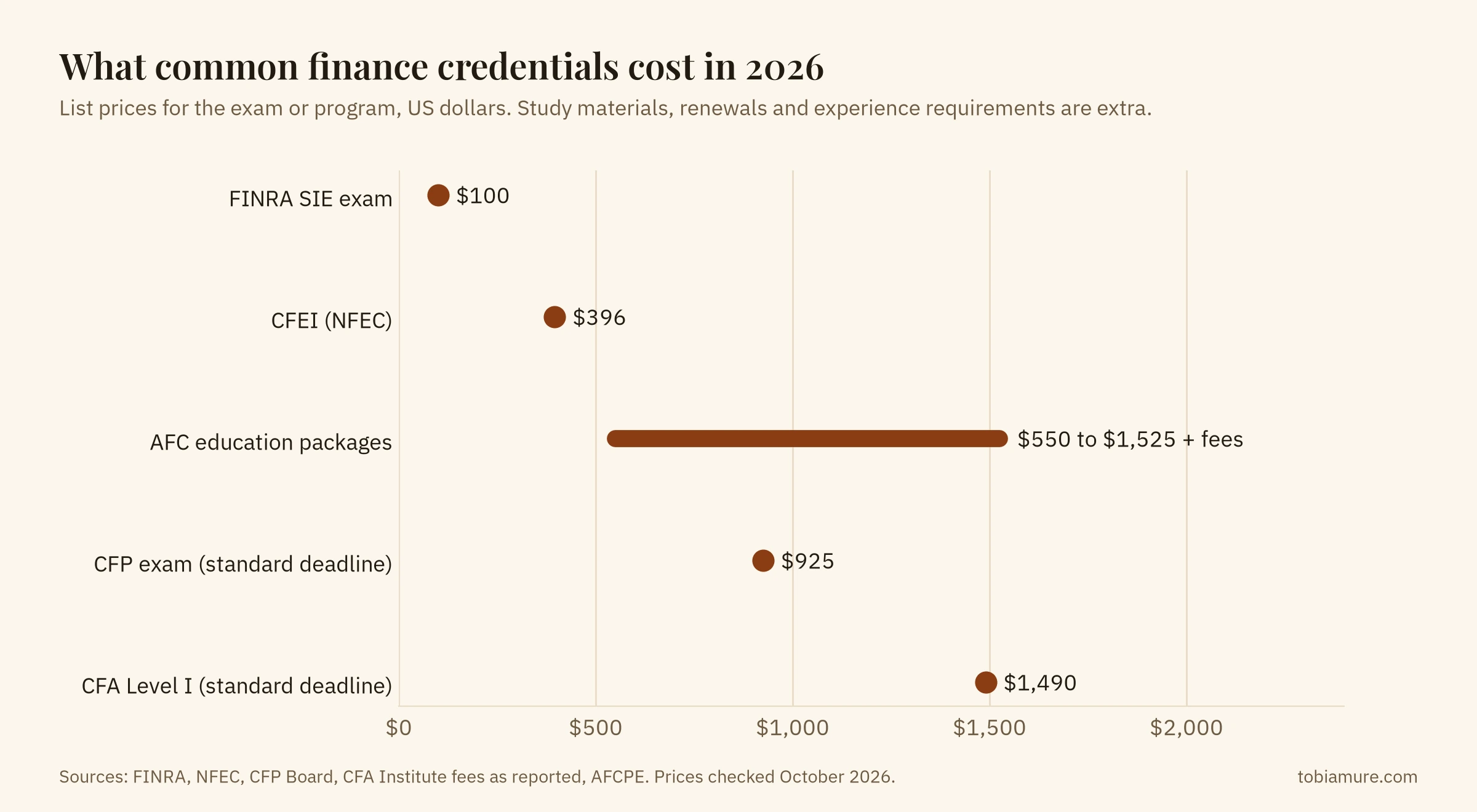
The SIE is the most underrated option for writers. It is "open to anyone aged 18 or older," you do not need to work for a firm, and it costs $100. Studying for it forces you to learn how stocks, bonds, options, funds and market rules actually work. Passing it does not license you to do anything on its own, so do not imply that it does.
I hold the CFEI, which costs $396 through the NFEC, plus $129 a year from the second year, and involves 20 to 30 hours of self-paced study and an online exam. FINRA's designation database lists it with no prerequisites and recertification every three years. It is an education credential, not an advisory licence. I value it because it shaped how I explain money, and I say exactly that when clients ask.
The CFP and CFA are serious professional designations. They take years and are built for planners and analysts, not writers. If you already hold one, it is a strong selling point. If you do not, you do not need one to start.
Choose a beat before you choose clients
"Finance" is too broad to sell. Editors hire writers who already know a corner of it.
A beat is the overlap between three things: a subject you can learn deeply, a set of clients who pay for it, and enough ongoing news that you never run out of ideas. Here is how the main beats compare.
| Beat | Who pays for it | Knowledge bar | Compliance exposure |
|---|---|---|---|
| Personal finance (budgeting, saving, credit, debt) | Consumer sites, banks, fintech apps | Low to start, high to stand out | Moderate, especially product reviews |
| Investing and markets | Investing sites, brokers, newsletters | High: valuation, filings, macro | High when writing for brokers or advisers |
| Banking and lending | Banks, lenders, comparison sites | Moderate | High for regulated firms |
| Payments and fintech infrastructure | Fintech and software companies, trade press | High: rails, settlement, regulation | Moderate |
| Crypto and digital assets | Exchanges, crypto media, fintechs | High, and the rules change fast | High in the UK, EU and Nigeria |
| Corporate finance and capital markets | B2B firms, trade titles, business press | High | Low to moderate |
| Tax and accounting | Accounting software, tax sites, firms | High, jurisdiction-specific | Moderate |
| Insurance and retirement | Insurers, comparison sites, advisers | Moderate to high | High |
Three tests help you choose.
Can you read the source documents? A payments writer reads card network rules and central bank papers. A markets writer reads 10-Ks and earnings call transcripts. If a beat's documents bore you, you will not last in it.
Is there a buyer with a budget? Search job newsletters and company blogs in the beat. If companies publish content regularly and hire freelancers to do it, there is money there.
Does the news keep coming? Payments, AI infrastructure and crypto regulation produced new stories almost every week in 2026. That is good for pitching and good for retainers.
My own beats grew out of crypto news, which led to payments and stablecoins, which led to AI infrastructure as the biggest capital spending story in markets. Each one connected to the last. That kind of adjacency is easier to build than jumping between unrelated topics.
The core skills editors test for
Most rejections in finance writing are not about style. They are about trust. Here are the skills that build it.
1. Reading primary documents
The single biggest step up for a new finance writer is going to the source. If a news story says a company's spending doubled, you open the company's release and check.
These are the documents you should be able to read quickly:
- Earnings releases and investor presentations. The headline numbers, guidance and segment results.
- Annual and quarterly reports (10-K and 10-Q in the US). The full financial statements, risk factors and the management discussion.
- Current reports (8-K). Material events, such as acquisitions, executive changes or new debt.
- Earnings call transcripts. What executives said, in their own words, including answers to analysts.
- Central bank and regulator publications. Rate statements, rules, consultations and enforcement actions.
- Official statistics. Inflation, jobs, GDP and rates data.
Two free tools do most of the work. The SEC's EDGAR full-text search covers the "full text of electronic filings since 2001" and lets you search a phrase across every company. The St. Louis Fed's FRED holds hundreds of thousands of economic time series and lets you chart and download them.
Here is what reading a release looks like in practice. When Alphabet reported its second-quarter 2026 results, its earnings release showed $44.9 billion of purchases of property and equipment, against $22.4 billion a year earlier. That is a 100% increase. The cash flow statement also showed $39.1 billion of operating cash flow, which means capital spending was larger than the cash the business generated in the quarter. That one comparison became a central point in my piece on Big Tech's AI build-out. The story was not in the press release headline. It was in the cash flow table.
The habit to build: for every number you publish, know which document it came from and which line.
2. Getting the numbers right
Numerical errors do the most damage to a finance writer's credibility. These are the ones to watch for:
- Percent versus percentage points. If a rate rises from 4% to 5%, it rose one percentage point, or 25%. Mixing them up is a frequent error in rates coverage.
- Year over year versus quarter over quarter. A 10% rise "this quarter" means nothing until you say compared with what.
- Revenue versus profit versus cash flow. These move differently. A company can grow revenue, report a profit and still burn cash.
- Nominal versus real. A 5% pay rise in a year of 4% inflation is about a 1% real rise.
- Annualised figures. A monthly rate multiplied by 12 is an estimate, not a fact. Label it.
- Basis points. One basis point is 0.01 percentage points. A 25 basis point rate cut is 0.25 points.
- Fiscal years. Microsoft's fiscal year ends in June. Nvidia's ends in late January. Always say which year you mean.
- Rounding and totals. If you round each item, the parts may not add up to the total. Say "about" or recalculate.
- Old data presented as current. A 2021 survey is a 2021 survey. Put the year in the sentence.
Do your own arithmetic. If you write that something "nearly tripled," divide the two numbers. If the answer is 2.4, it did not nearly triple.
3. Writing plainly
The SEC published a Plain English Handbook in 1998 for people who write disclosure documents. Its advice has not aged. Use the active voice, short sentences, everyday words and descriptive headings. In the preface, Warren Buffett suggests writing "with a specific person in mind."
In practice, that means:
- Define a term the first time you use it, in one short clause.
- Put the most useful fact in the first two sentences.
- Use one idea per paragraph, and keep paragraphs short.
- Prefer a specific number to an adjective. "Fees of $45 per wire" beats "high fees."
- Cut hedging that adds nothing, but keep hedging that is true. "Could" and "may" matter in finance.
Plain does not mean simple-minded. The goal is that a smart reader outside the industry understands it the first time.
4. Sourcing and attribution
Every claim needs a source, and the best source is the original one. If a news site reports a central bank decision, link the central bank. If a blog cites a survey, find the survey.
Attribute at the point of the claim, and name the venue. "The company said on its earnings call" is better than "according to reports." When a quote comes from someone else's interview, say so, and link it.
For interviews, record with permission, quote exactly, and confirm job titles. In finance, people's roles and their firms' regulatory status matter. Ask an interviewee whether they hold positions in anything they discuss.
5. Structure for search and for answer engines
Much finance content is found through search, and increasingly through AI answer tools. You do not need to be an SEO specialist, but you should be able to:
- Match the reader's question with a clear direct answer near the top.
- Use descriptive headings that reflect real questions.
- Add tables for comparisons and short lists for steps.
- Link internally to related pages and externally to primary sources.
- Write a clear title and meta description.
Google's Search Quality Rater Guidelines put finance under "Your Money or Your Life," described as topics that "could damage a person's ability to support themselves and their families." Pages on those topics are held to a higher standard of expertise and trust. Good structure helps, but accuracy and evidence of expertise matter more.
6. Working with editors
Editing in finance is closer than in most niches. Expect questions on numbers, sources and wording, and treat them as part of the job rather than criticism.
A few habits make you easy to work with:
- File clean copy. Run a spell check, check every link opens, and make sure every figure has a source.
- Flag what is uncertain. If a number came from a secondary source, or a company did not reply, say so in a note to your editor.
- Answer questions quickly, especially on news, where a delay can kill a story.
- Accept the house style. Some outlets want "percent," others "%." Some want US spelling, others UK spelling. Follow the guide.
- Do not argue over taste, but do defend accuracy. If an edit introduces an error, explain why politely and offer a fix.
Regulated clients add another layer. A compliance reviewer may ask you to remove a word like "safe" or "guaranteed," add a risk warning, or soften a claim. That is normal. Build the time into your schedule and your quote.
A worked example: from a filing to a publishable brief
It helps to see the process end to end. Here is how I would turn one earnings release into a short news brief.
Step 1: Go to the source. On Wednesday, August 26, 2026, Nvidia published its second-quarter results for its fiscal 2027. Start there, not with a news story about it.
Step 2: Find the headline numbers. Total revenue was $96.2 billion. Data center revenue was $89.0 billion, up 117% from a year earlier. Note the period: the quarter ended July 26, which is Nvidia's fiscal second quarter, not the calendar second quarter.
Step 3: Find the forward-looking number. Nvidia guided to revenue of about $108 billion, plus or minus 2%, for the current quarter, and said it was not assuming any data center compute revenue from China. That condition matters. Leave it out and the brief is misleading.
Step 4: Find the context. Read the earnings call transcript for what management said beyond the release. On the call, CFO Colette Kress said capital spending by the top five hyperscalers was "expected to reach nearly $800 billion in 2026 and $1.3 trillion in 2027," according to a published transcript. That tells readers why the results matter.
Step 5: Write the first sentence. Lead with the most important fact, the number and the attribution:
"Nvidia's revenue reached $96.2 billion in the quarter ended July 26, as data center sales rose 117% from a year earlier to $89.0 billion, the company said on Wednesday."
Step 6: Add the next most useful facts. The guidance and its China condition come second. The hyperscaler spending quote comes third, attributed to Kress and the call.
Step 7: Check everything. Recheck each number against the release. Confirm the fiscal period. Confirm the quote word for word against the transcript. Make sure each link opens.
That is the whole craft in miniature. The skill is not clever phrasing. It is going to the right document, choosing the facts that matter, and getting each one exactly right.
Accuracy and compliance: the part most guides skip
This section is where finance writing becomes different from other niches. Some of what you write may be regulated, even though you are not.
You are not usually the regulated party. Your client is. But if your copy breaks their rules, it will not be published, and you may not be hired again. Knowing the basics makes you easier to work with and lets you charge more.
United States
FINRA Rule 2210 covers communications by broker-dealers that are FINRA members. A "retail communication" is anything "distributed or made available to more than 25 retail investors within any 30 calendar-day period," and most must be approved by a registered principal before use, according to the rule text. Communications "must be fair and balanced." If you write for a brokerage, expect a compliance review, and avoid promissory language like "guaranteed returns."
The SEC Marketing Rule (Rule 206(4)-1) governs advertising by registered investment advisers, including testimonials and endorsements, according to the SEC's FAQ. If you write for an adviser, ask how they handle performance figures and testimonials before you draft.
The FTC finalised a rule in August 2024 that bans fake reviews and testimonials, including AI-generated ones, the agency announced. Civil penalties for knowing violations can reach $53,088 per violation, the inflation-adjusted level the FTC set in 2025 and kept for 2026. If a client asks you to write customer testimonials, the answer is no.
United Kingdom
The Financial Conduct Authority's guidance on financial promotions on social media, published in March 2024, warns that unauthorised influencers promoting financial products "may be committing a criminal offence." In 2024, the FCA charged nine people in what law firm Osborne Clarke described as the first time the FCA has sought to prosecute social media influencers. Since October 2023, UK crypto promotions have also needed approval from an authorised or registered firm, with a risk warning, under rules the FCA set out in its policy statement PS23/6.
Nigeria
Nigeria's Investments and Securities Act 2025 covers influencers and bloggers who promote fraudulent schemes, with penalties that include imprisonment, Premium Times reported in April 2025. The SEC's director-general told promoters to "immediately desist from promoting unregistered entities." If you write about investment platforms for a Nigerian audience, check the firm's SEC registration first.
A practical accuracy routine
Rules aside, this is the routine I would recommend to any new finance writer:
- Keep a source log. For every figure, note the document, page or table, and the date you accessed it.
- Check every number twice, once while drafting and once at the end, against the source, not your notes.
- Recalculate every comparison you make yourself, including percentages and multiples.
- Date-stamp time-sensitive facts. Rates, fees, thresholds and rules change. Write "as of October 2026."
- Disclose conflicts. If you hold an asset you write about, tell your editor. Many outlets require it. Benzinga's contributor guidelines, for example, ask writers to disclose "any conflicts of interest."
- Avoid personal advice language. Explain options and trade-offs. Do not tell readers what to buy unless the outlet's format and your status allow it.
- Add a clear disclaimer where the client requires one.
What AI changed, and how to work with it
AI has changed the market for finance writing more than anything else in the past three years. It is worth understanding exactly how.
The demand effect
Several peer-reviewed studies now measure what happened to freelance writing after ChatGPT launched in late 2022.
- A study by Xiang Hui, Oren Reshef and Luofeng Zhou in Organization Science found that writing-related freelancers on Upwork saw monthly jobs fall 2% and monthly earnings fall 5.2%, as summarised by VoxEU. The study later won an award, Washington University's Olin Business School noted.
- Ozge Demirci, Jonas Hannane and Xinrong Zhu found about a 21% drop in posts for writing and coding jobs within eight months of ChatGPT's launch, in a paper published in Management Science in 2025.
- Ole Teutloff and co-authors found that demand for substitutable skills such as writing and translation fell 20% to 50% below its prior trend, in a study in the Journal of Economic Behavior and Organization. The steepest falls were in short jobs of one to three weeks.
The pattern is consistent. Short, generic, easily specified writing jobs shrank first. Work that needs judgment, reporting or specialist knowledge held up better. I cover what that means for rates in my guide to finance writer pricing.
The trust effect
The second change is that publications have become much more careful.
In January 2023, CNET issued corrections on 41 of 77 stories it had published with AI assistance, Talking Biz News reported. In 2025, Wired, Business Insider and other outlets removed articles credited to a freelance byline, "Margaux Blanchard," that appeared to be AI-written, Press Gazette reported. In February 2026, Ars Technica retracted a story over "fabricated quotations generated by an AI tool," and in March the reporter was reported to have been fired, TheWrap reported. Press Gazette keeps a running tracker of AI journalism mistakes, and its 2026 entries include finance publications.
Outlets have responded with policies. Benzinga's guidelines reject submissions that "are, or seem, computer generated." NerdWallet's editorial guidelines say its writers "remain responsible for the accuracy of all editorial content." Search engines have tightened too. Google's 2023 guidance said "appropriate use of AI or automation is not against our guidelines," but its spam policies now target "scaled content abuse," meaning pages generated "for the primary purpose of manipulating search rankings," however they are made.
How to use AI without damaging your name
My rules are simple:
- Follow the client's policy first. Ask before you start. If there is no policy, ask what they are comfortable with and get it in writing.
- Never let a model write a fact, figure or quote you have not checked against the source. Models invent sources and numbers with confidence.
- Never fabricate or "tidy" a quote. Quote what was said.
- Use AI where it is strongest: summarising a long document you will then read yourself, suggesting questions for an interview, checking structure, or spotting repeated words.
- Disclose when required. If AI materially shaped the piece, say so to your editor.
The writers who will do well are not the ones who refuse every tool. They are the ones whose work an editor can publish without worrying.
Build a portfolio editors will trust
Your portfolio does one job: it proves you can produce accurate finance writing that is ready to publish. Three strong pieces do that better than twenty weak ones.
What to put in it
If you have no clients yet, write three samples in your chosen beat:
- An explainer that answers a real search question, with a table, primary sources and a clear structure.
- A news or analysis piece built on a primary document, such as an earnings release, a rate decision or a new rule.
- A piece that shows judgment, such as a comparison, a data-led piece or an interview with someone in the industry.
Keep each one current and dated. An editor reading your sample should be able to click every link and find the number you cited.
Where to publish samples
You have three good options:
- Your own site. A simple portfolio site with your bio, beats, samples and contact details is the strongest option. It also gives you somewhere to publish your own analysis, as this blog does.
- Contributor networks. Some outlets accept contributor submissions. Benzinga's guidelines describe an average article of 250 to 600 words and allow you to submit your work elsewhere too. Read each outlet's rules first.
- LinkedIn articles or a newsletter. Good for visibility in your beat. Damilola's guide is itself a good example of a LinkedIn article that does that job.
Once you have published bylines, collect them in one place. Muck Rack offers journalists a free profile and portfolio. Authory backs up your articles automatically, with a free plan for up to 10 items and paid plans from $9 a month billed yearly.
What an editor checks in 60 seconds
When an editor opens your portfolio, they usually look for:
- Bylines in or near their beat.
- Clean, specific headlines and a strong first paragraph.
- Links to primary sources.
- No obvious errors in the first few numbers.
- Evidence you can follow a brief, such as consistent structure and length.
- A clear way to contact you.
Where finance writing work comes from
There is no single best channel. Most working freelancers use three or four. Here is how they compare for a new finance writer.
| Channel | Best for | Pros | Cons |
|---|---|---|---|
| Pitching publications | Bylines, credibility, news and features | Builds your name, opens doors | Rejection is normal, some outlets pay modestly |
| Direct outreach to companies | Steady, better-paid B2B work | Retainers, higher rates | Needs a strong portfolio and research |
| Job newsletters and boards | Finding open briefs quickly | Curated, time-saving | Competitive, some are paid |
| Freelance marketplaces | First paid work, testimonials | Easy to start | Fees, price competition |
| Referrals and networks | Best long-term source | Warm leads, less competition | Takes time to build |
| Agencies | Volume and variety | Brief-driven, regular | Lower rates, less ownership |
Job newsletters and boards worth knowing
These were active in 2026. Check each one's current pricing and focus before you pay for anything.
- Study Hall offers annual memberships from $99 to $199 and a database of more than 2,500 commissioning editors. Sonia Weiser's Opportunities of the Week newsletter is now part of Study Hall, she said in 2024.
- The Writer's Job Newsletter sends a free issue each week and a second weekly issue to paid subscribers. Writer's Digest put its readership above 13,000 in its 2026 list of the best job and market websites for writers.
- All Things Freelance Writing, run by finance writer Jessica Walrack, sends a free weekly roundup of at least 25 vetted gigs, with a paid tier for more.
- Freelance Framework sends regular lists of freelance writing gigs.
- Peak Freelance runs a community for creative freelancers, many of them writers, with more than 5,000 members.
- Freedom With Writing publishes regular lists of paying markets.
- Mediabistro lists media and content jobs, including freelance roles.
Social media still matters. Finance writers, editors and content leads are active on LinkedIn and X, and many briefs appear there before they reach a job board. Follow the editors of the outlets you want to write for.
Freelance marketplaces
Upwork charges freelancers "a variable freelancer service fee ranging from 0-15% on all earnings," according to its fee calculator. Fiverr also takes a share of each order. Check both platforms' current fee pages before you price.
Marketplaces can get you your first paid work and reviews. They are rarely where the best finance work lives, because price competition is intense and buyers often want speed over depth. Treat them as a starting point, not a business model.
How to pitch a publication
A pitch is a short email that sells one idea to one editor. Editors receive many of them, so yours needs to be easy to say yes to.
A good finance pitch has five parts:
- A specific subject line. "Pitch: Why stablecoin rewards for startups may stop in January" beats "Article idea."
- The news hook in one or two sentences. What changed, when, and why readers of this outlet should care now.
- The angle. What your piece will show that others have not, and the primary sources or data behind it.
- The outline. Three or four short bullet points, plus a rough word count.
- Why you. One or two sentences with your most relevant bylines, linked.
Keep it under 250 words. Read the outlet first, so your idea fits its audience and format. Pitch one outlet at a time with a time-sensitive idea, and if you have heard nothing after about a week, send one short follow-up, then move on.
Here is a template you can adapt. The details in brackets are placeholders.
Questions to ask a new client
Before you start work for a new client, especially a company rather than a publication, ask:
- Who is the reader, and what should they know or do after reading?
- Is there a style guide, a brief template and examples of pieces you like?
- Does a compliance team review content, and how long does that take?
- What is your policy on AI tools?
- Can I interview people inside the company, or customers?
- Will my name appear on the piece, and can I show it in my portfolio?
- What are the payment terms, and how do you pay international contractors?
The answers tell you how long the work will really take, and they help you price it properly.
How to approach companies directly
Fintechs, banks, asset managers and financial software companies publish a lot of content and often need writers who understand their product. To approach one:
- Read their blog, resources and recent announcements.
- Find the right person, usually a head of content, content marketing manager or communications lead.
- Send a short, specific note: who you are, your beat, two relevant samples, and one or two content ideas that fit their audience.
- Follow up once.
Specific ideas win. "I can write about payments" is easy to ignore. "Your new cross-border payouts product could anchor a guide for marketplace sellers on settlement times and FX costs" gives them something to approve.
How to price your work
Pricing is a full topic on its own, so I wrote a separate guide to freelance finance writer rates with benchmarks by format and my own published rates. Here are the essentials for beginners.
- Price per article or per project, not per hour, once you know your speed. It is easier for clients to budget and rewards you for getting faster.
- Use published benchmarks as a reference. The Editorial Freelancers Association's 2026 rate chart, based on a survey of more than 1,100 editorial professionals, puts work-for-hire business and marketing writing at 32 to 87.5 cents a word and ghostwritten business and marketing content at 50 cents to $1.
- Raise rates as your evidence grows. Each strong byline, testimonial or result is a reason to charge more for the next client.
- Price the reporting. Interviews, original data and same-day turnaround take time. Quote for them separately.
The biggest pricing mistake new writers make is anchoring on the lowest rates they see on marketplaces. Specialist finance work is priced differently, because the cost of an error is higher.
Run it like a business
Freelance finance writing is a small business. The admin is dull but it protects you.
Contracts
Use a written agreement for every client, even a short one. It should cover:
- The scope: format, word count, number of revisions and deadlines.
- The fee and when it is paid.
- Who owns the work and whether you can show it in your portfolio.
- A kill fee if the client cancels after you start.
- Late payment terms.
- The client's AI policy and any disclosure rules.
Getting paid across borders
If you work with clients in other countries, compare the total cost of each payment route, including fees and the exchange rate, not just the transfer fee. Bank wires, payment platforms and stablecoins all have trade-offs. I break down the costs and rules in my guide to getting paid in stablecoins as a freelancer.
I run my own freelance business through a US-registered company, which helps when working with US clients. Whether that makes sense for you depends on where you live and where your clients are. Get professional advice before you set up an entity in another country.
Records and tax
Record every invoice, every payment, its date and its value in your home currency. Freelance income is taxable in most countries, and tax authorities increasingly receive data from payment platforms. Speak to an accountant in your country early, not in the week before a deadline.
A 90-day plan to land your first finance clients
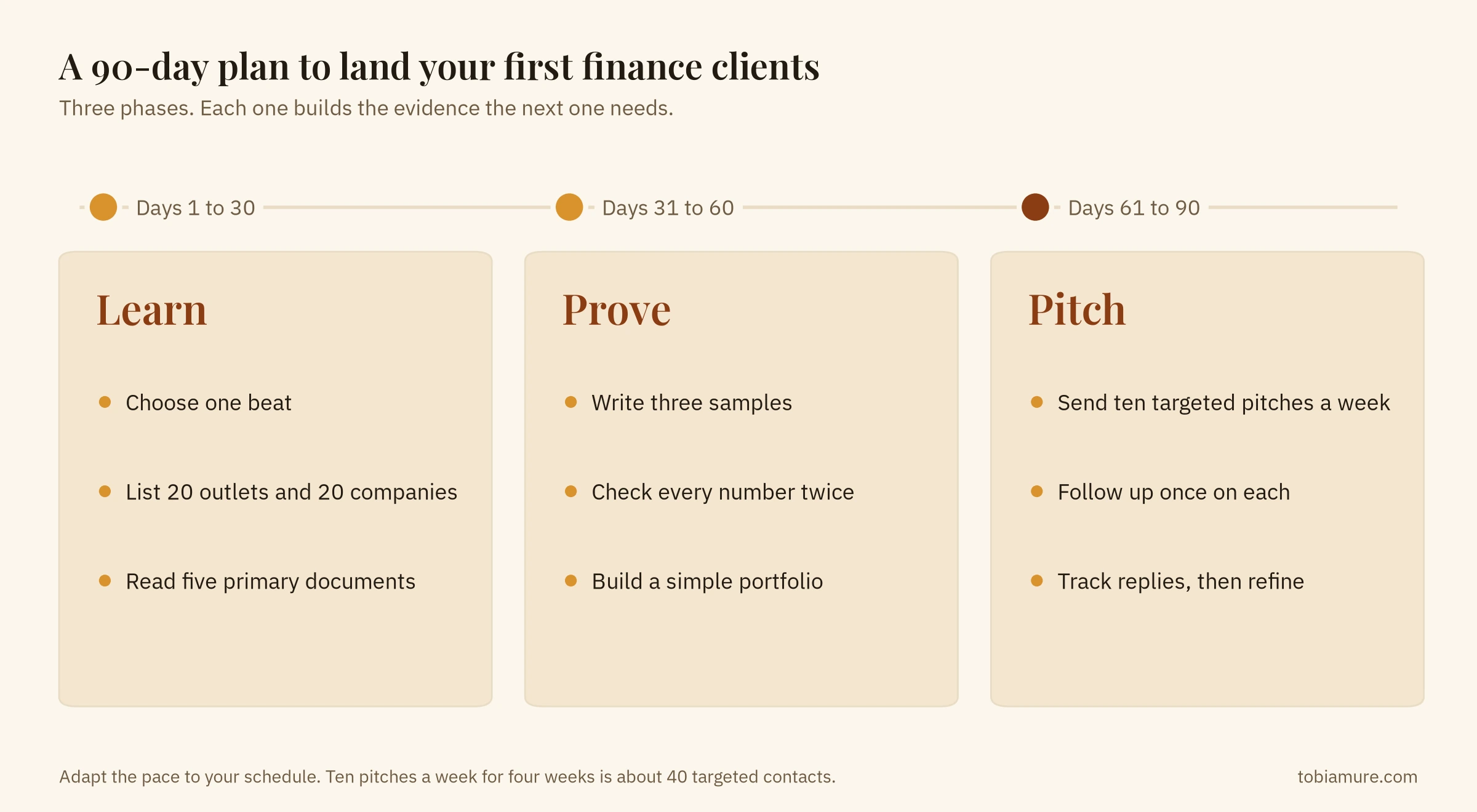
Here is a plan that turns everything above into weekly actions. Adjust the pace to your schedule.
| Weeks | Focus | Actions |
|---|---|---|
| 1 to 2 | Choose your beat | Pick one beat using the three tests above. List 20 publications and 20 companies that publish in it. |
| 3 to 4 | Learn the documents | Read five primary documents in your beat, such as two earnings releases, one regulator publication and two official data releases. Start studying for the SIE if you want structure. |
| 5 to 6 | Write samples | Write your explainer and your news or analysis sample. Check every number against the source. |
| 7 to 8 | Build your portfolio | Write your third sample. Set up a simple portfolio site, Muck Rack profile and LinkedIn summary that name your beat. |
| 9 to 10 | Start pitching | Send ten targeted pitches or outreach emails a week. Subscribe to two job newsletters and apply to relevant briefs. |
| 11 to 12 | Follow up and refine | Follow up once on every pitch. Note which ideas got replies. Raise your rate for the next quote if a client accepts quickly. |
| 13 | Review | Count pitches, replies and commissions. Keep what worked and drop what did not. |
Ten pitches a week over four weeks is 40 targeted contacts. If your samples are strong and your ideas are specific, that is enough to start a conversation with several editors or clients. Track the numbers so you can see what is working.
Mistakes that cost new finance writers work
These are the patterns that most often get finance writers dropped. All of them are avoidable.
- Citing aggregators instead of sources. If your link goes to a summary of a summary, editors notice.
- Out-of-date figures. Rates, fees and tax thresholds change. A guide with last year's numbers is wrong.
- Advice the writer is not qualified to give. "You should buy this stock" is not your call to make in most formats.
- Unclear AI use. Breaking a client's AI policy is one of the fastest ways to lose them.
- Overpromising on turnaround. Missing a deadline on time-sensitive news is worse than turning it down.
- Generic pitches. An idea that could go to any outlet usually goes nowhere.
- No disclosure of conflicts. If you hold what you write about, say so.
- Ignoring the brief. A well-written piece that misses the brief is still a miss.
Terms you must get right
Misused terms are a quick signal to an editor that a writer is new to finance. These are the ones worth learning first.
| Term | What it means | Common mistake |
|---|---|---|
| Revenue | Money a company brings in from sales, before costs | Calling it profit |
| Net income | Profit after all costs, interest and taxes | Confusing it with operating income |
| Operating cash flow | Cash generated by the business's normal operations | Assuming it equals profit |
| Free cash flow | Operating cash flow minus capital spending, as most companies define it | Ignoring that definitions differ by company |
| Capital expenditure (capex) | Spending on long-lived assets such as buildings, servers and equipment | Treating it as an expense in the period it is spent |
| Guidance | A company's own forecast for a future period | Reporting it as a result |
| Basis point | One hundredth of a percentage point | Writing "25 basis points" as 25% |
| APR and APY | APR is a borrowing cost, APY is the yield on savings including compounding | Using them interchangeably |
| Yield | The income an investment pays, as a share of its price | Mixing it up with total return |
| Market capitalisation | Share price multiplied by shares outstanding | Calling it the company's value in every sense |
| Stablecoin | A crypto token designed to hold a steady value, usually one US dollar | Calling every stablecoin "backed by dollars" |
| Settlement | The point at which a payment or trade is final | Assuming it happens when a payment is sent |
When in doubt, check the definition in the company's own filing or a regulator's glossary, and use the company's own terms when you quote its numbers.
Resources worth bookmarking
- SEC EDGAR full-text search for company filings
- FRED for economic data
- SEC Plain English Handbook for clear writing
- Google Search Quality Rater Guidelines for how finance content is judged
- FINRA Rule 2210 for broker-dealer communications
- FCA guidance on financial promotions on social media for UK work
- FINRA's professional designations database to check what a credential means
- Bankrate's Financial Review Board as an example of how a major finance site reviews content
Where to go from here
Finance writing rewards people who are careful, curious and consistent. You do not need permission or a particular degree to start. You need one beat, three accurate samples and the patience to pitch well.
If you are a writer starting out, I hope this saves you some of the trial and error. If you are an editor or a company looking for a finance writer, you can see my rates in my pricing guide or get in touch here.
Frequently asked questions
No. Many finance writers come from journalism, English, science or other careers. What editors check is whether your numbers are right, your sources are primary, and your writing is clear. A credential such as the SIE or CFEI can help you learn, but published, accurate work matters more.
It varies widely. The US Bureau of Labor Statistics put median pay for writers and authors at $76,910 in May 2025, and 65% of writers are self-employed. The Editorial Freelancers Association's 2026 chart puts work-for-hire business and marketing writing at 32 to 87.5 cents a word. Specialist finance writers usually price per article or on retainer.
The most reliable routes are pitching publications directly, approaching fintech and financial companies that publish content, writer job newsletters such as Study Hall, The Writer's Job Newsletter and All Things Freelance Writing, and referrals. Freelance marketplaces like Upwork can work early on, but fees and competition are high.
Usually for research support and editing, if your client allows it, but not to generate published copy without disclosure. Many outlets ban or restrict AI-written content, and several publications removed or retracted AI-assisted articles in 2025 and 2026. You remain responsible for every fact and quote.
Specialist B2B work, such as payments, capital markets, asset management, fintech infrastructure and research reports, tends to pay more than general personal finance, because fewer writers can do it accurately. Regulated work for banks, brokers and advisers also pays more, but involves compliance review.
Related articles

12 Finance Writers Worth Following in 2026
Twelve working finance writers whose bylines are worth reading in 2026, from markets and AI infrastructure to loans, insurance and retirement, with links to their recent work.

Big Tech's $720 Billion AI Build-Out: What Q3 2026 Earnings Need to Show
Amazon, Alphabet, Microsoft and Meta plan to spend at least $720 billion on capital projects in 2026. Here are the numbers behind the plans, who is paying for them, and what to watch as Q3 results land.

Getting Paid in Stablecoins as a Freelancer in 2026: Costs, Rules and Risks
Stablecoins can cut the cost and wait of cross-border invoices, but the savings depend on the ramps, not the blockchain. Here is how the money moves, what it costs, and what the 2026 rules mean in the US, EU, UK and Nigeria.